
To clean a milk spill in your car, blot up as much liquid as you can right away, rinse the spot with cool water, blot again, then treat it with an enzyme-based cleaner and keep the area moist for the full dwell time. Skip the heat, skip the hard scrubbing, and do not cover the smell with an air freshener. Milk is protein and fat, and if any of it stays in the carpet or seat foam, bacteria will feed on it and the sour smell comes back, usually on the first hot day.
This guide walks through the first ten minutes, the full cleanup, what to do when the smell has already set in, and the point where a mobile detailer is the cheaper choice than a fourth failed attempt.
TL;DR
- Act fast: blot (never rub) and rinse with cool water. Heat and hard scrubbing set the stain and push milk deeper into the padding.
- Soap alone will not finish the job. An enzyme cleaner is what digests the milk protein that causes the sour odor.
- Let the enzyme cleaner sit 10 to 30 minutes and keep it damp. Then extract the liquid with a wet vac or towels and let the area dry fully.
- Air fresheners only mask the smell. If the odor returns, milk has soaked into foam, a seat seam or under the carpet.
- A deep spill, a gallon, or a smell that is weeks old is a job for professional extraction. We come to you in South Jersey.
Table of Contents
- Why milk is worse than most spills
- The first ten minutes
- Full cleanup: fabric seats and carpet
- Leather, vinyl and hard surfaces
- Spilled milk smell in the car: when it is already sour
- DIY or professional: a quick way to decide
- What we do when a customer calls about spilled milk
- What a professional cleanup costs with us
- How to prevent the next spill
- Mistakes that make a milk spill worse
- A note on other messy car cleanups
- FAQ
- Sources
Why milk is worse than most spills
Coffee and soda leave a sticky stain. Milk leaves a stain and a slow-motion problem. It is a mix of protein and fat, and once it warms up inside a closed car, it spoils. The sour smell is not the milk itself; it is the result of bacteria breaking it down. That is why a spill you thought you cleaned can smell fine for a day and then turn foul.
Car interiors make this worse in three ways:
- Cabin heat. A parked car in a New Jersey July can get far hotter than the air outside, which speeds up bacterial growth.
- Absorbent layers. Carpet sits on a pad, and the pad sits on the floor pan. Milk wicks down through all three and can pool where you cannot see it.
- Hidden spots. Seat rails, the gap beside the console, the seatbelt buckle pocket and the underside of a seat are easy to miss, and even a small missed spot can leave the car smelling bad.
The practical takeaway: the goal is not a dry-looking carpet. The goal is removing the organic material from every layer the milk reached.
The first ten minutes
What you do right after the spill matters more than any product you buy later.
- Stop the spread. Set the container upright, and if it is a leaking carton or bottle, take it out of the car.
- Lift off the solids. If there is cottage cheese-like curd, cereal or a milkshake’s whipped topping, scoop it up with a spoon or a piece of cardboard. Do not press it into the fabric.
- Blot, do not rub. Press a clean microfiber towel or paper towels onto the spill and lift. Switch to a dry section of towel each time. Pat the spill dry immediately is the consistent advice, because the quicker you act, the less the stain sets.
- Open the doors. Airflow helps, and it spares you the fumes of whatever you use next.
The common mistake here is scrubbing. Textile care guidance from the University of Georgia extension covers milk as a protein-based stain, and the practical lesson for a car is the same: heat sets protein, and scrubbing drives the liquid down into the padding where you cannot reach it.
Full cleanup: fabric seats and carpet
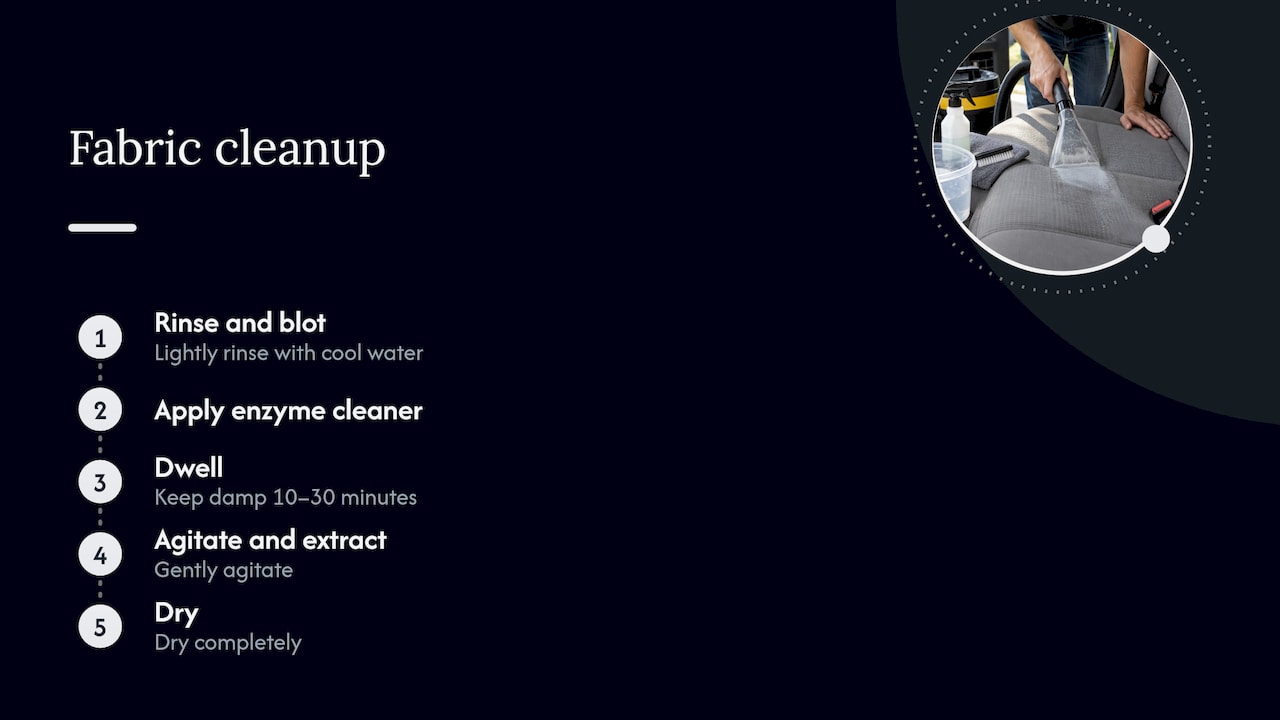
You need: microfiber towels, a spray bottle of cool water, an enzyme-based interior cleaner, a soft brush, and ideally a wet/dry vacuum. A household vacuum is not safe on wet fabric.
Step 1: Rinse with cool water
Lightly spray the stain with cool water, then blot. Repeat a few times. You are diluting and lifting, not soaking. Hot water is the wrong move, because heat sets protein stains. Do not flood the floor either: the more water you add, the further the milk travels and the longer the carpet takes to dry.
Step 2: Apply an enzyme cleaner
Standard detergents lift surface dirt but do not break down milk’s protein and fat. Professional-grade enzyme interior cleaners are designed to digest organic stains and odors in automotive carpet, upholstery and seat foam. Look for a product that says it contains protease (for protein) and lipase (for fat), and that is labeled safe for automotive fabric. Another example is a concentrated bacterial carpet and upholstery formula made for organic stains and odors.
Apply it to the whole affected area, plus a margin around it. Milk spreads wider than the visible stain, so treat the edges too. Follow the label for dilution.
Step 3: Let it work, and keep it damp
This is the step most people rush. Enzymes need time, and they need moisture. Plan on a dwell time of 10 to 30 minutes, and if the area starts to dry out, mist it lightly. A spill that has been sitting for days may need a second round.
Step 4: Agitate gently and extract
Work the area with a soft brush using light, short strokes. Then pull the liquid out. A wet vac is best because it removes the dissolved milk along with the water. No wet vac? Press clean, dry towels into the carpet, stand or kneel on them to wick moisture up, and replace them as they soak through. Repeat until the towel comes up nearly dry.
Step 5: Dry completely
A damp carpet is where mildew starts, and mildew smells nearly as bad as sour milk. Park in the sun with the windows cracked, run a fan inside the cabin, or run the heater with the windows slightly open. Pull the floor mats and dry them separately. Check the area again after 24 hours: press a clean white towel into the spot. If it smells sour or feels cool and damp, the milk reached the padding.
Leather, vinyl and hard surfaces
Milk on leather or vinyl is easier because the liquid sits on top. Wipe it up, then clean with a pH-balanced interior cleaner on a microfiber towel. The real trouble is seams and perforations. If milk ran into the stitching or through perforated leather holes, it can reach the foam below, and you will need a gentle enzyme treatment applied sparingly there. Do not saturate perforated leather: the foam under it holds liquid for days.
Don’t forget the places liquid runs to:
- The seat rails and the carpet underneath the seat
- Seatbelt buckles and the slots beside the seat bottom
- Door pockets and cup holders
- The gap along the center console
- Under the floor mat, where liquid gathers on the carpet
For more on handling stains on upholstery, our guides on removing stains from car seats naturally and step-by-step car stain removal cover the general method.
Spilled milk smell in the car: when it is already sour
If the spill is days old, the stain is the least of it. The smell tells you bacteria are active. The only lasting fix is to remove their food source, and that means an enzyme treatment that reaches every layer the milk reached. A mask will not do it: masking the scent with sprays or air fresheners never resolves the issue, because the organic residue is still there feeding the bacteria.
What tends to work, in order:
- Find the source. Sniff the carpet, seat bottoms and seams. Pull the mats. Lift the seat if it moves. The smell is strongest at the source.
- Treat and extract. Use the enzyme steps above, with generous but not flooding application on the smelly area. Expect a possible second round.
- Dry fully. Moisture left behind is the common reason the smell seems to return.
- Air out. Once the source is gone, ventilate the car for a day. A odor neutralizer is fine at this point, because now it is finishing the job rather than hiding it.
How long does the smell take to go away? It depends on the spill, not the calendar. If you removed the milk from the carpet and padding, the odor fades as the area dries, often within a day or two. If any milk is left, no amount of time will fix it, and the smell will get worse in warm weather. Our guide to car odor removal goes deeper on the causes.
One more thing worth knowing: the air conditioning can spread the smell. Vents circulate odor through the cabin, and a sour car often is a car with a wet spot somewhere plus a musty vent. If the smell persists after the carpet is clearly clean and dry, mention it to your detailer.
DIY or professional: a quick way to decide
| Situation | DIY is realistic | Call a pro |
|---|---|---|
| A few ounces, caught within an hour | Yes | No |
| A cup or more on carpet | Possibly, with a wet vac | If you have no extractor |
| Spill soaked into seat foam or under the seat | Rarely | Yes |
| Milk spilled days or weeks ago | Hard | Yes |
| A gallon or a leaking jug in the trunk or footwell | No | Yes |
| Smell is back after one cleaning | No | Yes |
| Baby seat, child or allergy concerns | Depends | Often yes |
A professional has two advantages that are hard to copy at home: a hot-water extractor that pulls liquid out of the padding instead of pushing it in, and the experience to find the hidden spot. Most failed DIY attempts fail because one wet pocket was missed.
What we do when a customer calls about spilled milk
We are a mobile detailer based in Pitman, so the car does not have to go anywhere. We come to your driveway or workplace in South Jersey, look at the spill, and tell you honestly what it needs. Sometimes a good interior detail is enough; sometimes the foam has to be treated on its own.
Perspective from our shop
The most common story we hear is not “I spilled milk.” It is “I cleaned it, it smelled fine, and two weeks later the car stank.” That is the pattern we see because people clean what they can see. Milk does not stay where it lands. It runs under the seat, along the rail, down into the pad. Our approach is to treat the smell as a biological problem, not a cosmetic one: find where the milk went, remove it from every layer, and dry the area properly before calling it done. We would rather spend an extra twenty minutes locating the wet spot than send you home with a car that smells like a fresh air freshener over a sour carpet. If you have a child seat in the car, tell us, because we will clean around the straps and fabric with extra care. And if a spill is small and fresh, we will tell you to handle it yourself with the steps above. It costs you nothing to ask.
— Charles
What a professional cleanup costs with us
Prices below are what we publish on our site. Your quote depends on the vehicle and the extent of the spill, so the best step is to send us a description and a photo.
- Interior Detail: from $275. This is the usual starting point for a spilled-milk job, when the damage is in the cabin.
- Detail packages: the Bronze Package starts at $375, Silver at $600, Silver+ at $1,000 and Gold at $1,500, if you want the whole car refreshed at the same time.
- Mobile service: a mobile detailing additional fee applies, from $100, and there is a $100 booking charge.
If the car is also overdue for a full clean, our full-service detailing overview explains what a complete detail covers, and our guide on selecting a detailing package helps you pick the right level. If you are not sure whether you need us yet, here are seven signs you need professional detailing help.
Ready to book? Start on our Interior Detail page or reach us through cdcautodetailing.com.

How to prevent the next spill
Nobody can prevent every spill, but a few habits make the next one a non-event.
- Keep a kit in the trunk. Two microfiber towels, a small spray bottle of water and a roll of paper towels turn a disaster into a two-minute job.
- Use all-weather floor mats. Deep-channel rubber or TPE mats hold liquid before it reaches carpet. Pull them out and rinse when a spill happens.
- Buckle groceries in. Milk jugs tip over on the first turn. A cargo net, a laundry basket or a bin in the trunk keeps them upright.
- Seal sippy cups. If you have kids, choose spill-proof cups for car trips, and keep the seat covers washable.
- Clean sooner, not later. Within the hour is the goal. Within the day is acceptable. After a week is a project.
- Keep the cabin clean generally. Routine care makes any spill easier. See our interior cleaning workflow and car interior cleaning tips for a routine you can actually keep.
Mistakes that make a milk spill worse
- Using hot water or a steamer first. Heat sets the proteins in the stain.
- Scrubbing hard. It pushes the liquid into the padding and frays the fabric.
- Pouring on baking soda and leaving it. It can absorb some odor, but it does nothing about the milk already in the foam, and it makes the carpet harder to extract.
- Soaking the area. Excess water makes drying slow and invites mildew.
- Using only a spray-on air freshener. It hides the symptom. The sour smell will resurface.
- Waiting. A fresh spill can be a ten-minute job. A week-old spill is often a two-round enzyme treatment.
A note on other messy car cleanups
The same logic applies to other organic spills such as baby formula, smoothies, pet accidents and spoiled takeout: remove the material, break down the residue with an enzyme product, dry thoroughly. For sand and salt after a beach day, the approach is different: rinse the exterior thoroughly before any scrubbing so you do not grind grit into the paint, then vacuum the interior dry before you wipe anything. If you want an expert view on tough interior stains, our guide on how to remove car stains is a good next read, along with cleaning auto upholstery naturally.
FAQ
What do I do if I spilled milk in my car?
Blot up as much as you can immediately with clean towels, then rinse the spot lightly with cool water and blot again. Follow with an enzyme-based interior cleaner, let it sit for 10 to 30 minutes while keeping it damp, and extract the liquid. Finish by drying the area completely. Do not use hot water or scrub hard.
How long does sour milk smell take to go away?
It depends on whether any milk is left in the carpet or foam. If you removed it from all layers and the area dried, the smell usually fades within a day or two. If it does not fade, or it gets stronger in warm weather, milk is still in there and the spot needs another enzyme treatment or a professional extraction.
Will baking soda or an air freshener get rid of the milk smell?
Not on their own. They can reduce odor in the air, but the milk residue stays and bacteria keep feeding on it, so the smell comes back. Enzyme cleaner that digests the protein and fat is what fixes the cause. Use deodorizers only after the source is removed.
How do I get old milk smell out of car carpet?
Find the exact spot first, since the smell is strongest there, and lift the mats and seat if you can. Apply an enzyme cleaner generously, keep it wet for the full dwell time, then extract with a wet vac and dry thoroughly. A spill that reached the padding or seat foam often needs a second treatment or a professional hot-water extraction.
Can you come to my house to clean a milk spill?
Yes. We are a mobile detailer serving South Jersey, so we work at your home or workplace. A mobile fee of from $100 and a $100 booking charge apply, and our Interior Detail starts from $275. Send us a description of the spill through our site and we will tell you what the job needs.
Sources
- Simple Ways to Remove Milk Stains from Car Upholstery (wikiHow)
- Remove Stains From Oil-Based Foods (University of Georgia Extension)
- Bio-Zyme Enzyme Automotive Interior Cleaner (product page)
- Alken Clear-Flo 5202 carpet and upholstery cleaning compound
- How to Properly Clean Your Car After a Day at the Beach