
TL;DR:
- Commercial fleet service encompasses maintenance, compliance, fuel management, safety, appearance, and upgrades.
- Key benchmarks include 95% plus preventive maintenance compliance and under 12 hours unplanned downtime per vehicle.
- Regular professional detailing enhances vehicle longevity, brand image, and resale value in South Jersey.
Most business owners think commercial fleet service means oil changes, tire rotations, and occasional repairs. That’s a costly misconception. The full scope of professional fleet care covers compliance tracking, fuel management, brand image, driver safety, and vehicle appearance — all of which directly affect your bottom line. For South Jersey businesses running delivery vans, service trucks, or branded company cars, neglecting any one of these areas can mean lost contracts, fines, and a damaged reputation before a customer ever meets your team. This article breaks down what commercial fleet service actually covers, which benchmarks matter most, and how appearance management fits into a winning fleet strategy.
Table of Contents
- What is commercial fleet service?
- Key components and benchmarks of effective fleet service
- Appearance and business image: why detailing matters
- Special considerations for different fleet types
- Why business owners often underestimate the value of fleet service
- Mobile detailing: the simplest way to boost your fleet’s value
- Frequently asked questions
Key Takeaways
| Point | Details |
|---|---|
| Not just maintenance | Commercial fleet service includes regular detailing, compliance, and cost management—not just repairs. |
| Monitor key benchmarks | Tracking compliance, downtime, and costs helps maintain a reliable and efficient fleet. |
| Frequent detailing boosts image | Regular professional detailing creates positive business impressions and protects resale value. |
| Tailor solutions by fleet type | Heavy-duty, electric, and high-visibility vehicles require specialized fleet service approaches. |
What is commercial fleet service?
Fleet service isn’t a single task — it’s a system. Commercial fleet services refer to comprehensive management and maintenance solutions for business-owned vehicle fleets, including preventive maintenance, repairs, compliance, fuel management, telematics, and specialized care to minimize downtime and costs. Understanding this definition is the first step toward building a smarter operation.
For a South Jersey contractor running six vans or a regional delivery company with thirty trucks, the goal is the same: keep every vehicle on the road, looking sharp, and meeting legal requirements without breaking the bank. That requires juggling several interconnected service categories simultaneously.
Here are the core service categories every fleet manager should know:
- Preventive maintenance: Scheduled oil changes, filter replacements, brake inspections, and fluid checks to catch problems before they become expensive
- Compliance management: Ensuring vehicles meet DOT regulations, emissions standards, and state inspection requirements — critical for avoiding fines and keeping licenses active
- Fuel management: Tracking fuel consumption per vehicle, identifying inefficient drivers or routes, and managing fuel card programs to control spending
- Telematics and GPS: Real-time vehicle tracking, driver behavior monitoring, and mileage reporting that feed into smarter scheduling and maintenance windows
- Vehicle detailing and appearance care: Interior and exterior cleaning, paint protection, and branding consistency — explore the full range of fleet detailing types to understand your options
- Upgrades and modifications: Lift kits, suspension improvements, cargo organization, and technology upgrades tailored to specific vehicle roles
To help clarify how different management approaches compare, here’s a quick breakdown:
| Service model | What’s included | Best for |
|---|---|---|
| Routine maintenance | Oil changes, tire rotations, inspections | Small owner-operated fleets |
| Full fleet service | Maintenance + compliance + fuel + detailing + telematics | Mid to large commercial fleets |
| Unbundled management | Pick and choose individual services from separate vendors | Businesses wanting direct cost control |
The fundamental reason this matters for your business is simple: unexpected breakdowns don’t just cost repair money. They cost delivery windows, customer trust, and employee productivity. A single vehicle sitting idle for two days can easily generate more financial damage than a full year of preventive service would have cost. Building a structured, multi-layered fleet service plan is the difference between reactive firefighting and confident, predictable operations.
Key components and benchmarks of effective fleet service
With a solid definition in mind, understanding what separates average from excellent fleet servicing is crucial. Setting expectations with your service provider — and with yourself — requires knowing which numbers actually matter.
Fleet maintenance KPIs give us clear empirical benchmarks: PM (preventive maintenance) compliance should sit at 95% or higher, Mean Time Between Failures (MTBF) should fall between 20,000 and 30,000 miles, Mean Time To Repair (MTTR) should be under 24 hours, maintenance cost per mile should range from $0.15 to $0.22, repeat repairs should account for less than 5% of all work orders, and unplanned downtime should stay below 8 to 12 hours per vehicle per month. These aren’t aspirational targets — they’re the numbers top-performing fleet operations actually hit.
Here’s what each of these metrics means in plain terms:
- PM compliance (95%+): This is the percentage of scheduled preventive maintenance tasks that get completed on time. If your team skips or delays oil changes and inspections, this number drops — and failures climb.
- MTBF (20,000 to 30,000 miles): Mean Time Between Failures measures how far your vehicles travel, on average, before experiencing an unplanned mechanical issue. Higher is better.
- MTTR (under 24 hours): Mean Time To Repair tracks how quickly your team or vendor gets a broken vehicle back on the road. Every hour counts when customers are waiting.
- Maintenance cost per mile ($0.15 to $0.22): This is your true operational cost benchmark. If you’re spending significantly more per mile, your maintenance strategy needs a review.
- Repeat repairs (under 5%): A repair that gets done twice is a failure of diagnosis. High repeat repair rates signal poor technician quality or systemic issues being patched instead of fixed.
- Unplanned downtime (under 12 hours/vehicle/month): This is arguably the most business-critical metric. Time off-road directly translates to lost revenue and operational disruption.
Here’s a visual summary of what these benchmarks mean and how to use them:
| Metric | Industry benchmark | What poor performance looks like |
|---|---|---|
| PM compliance | 95%+ | Vehicles breaking down mid-route |
| MTBF | 20,000 to 30,000 miles | Frequent, costly unplanned repairs |
| MTTR | Under 24 hours | Vehicles sitting idle for days |
| Cost per mile | $0.15 to $0.22 | Budget overruns every quarter |
| Repeat repairs | Under 5% | Same issues returning repeatedly |
| Unplanned downtime | Under 12 hrs/vehicle/month | Missed deliveries and customer complaints |
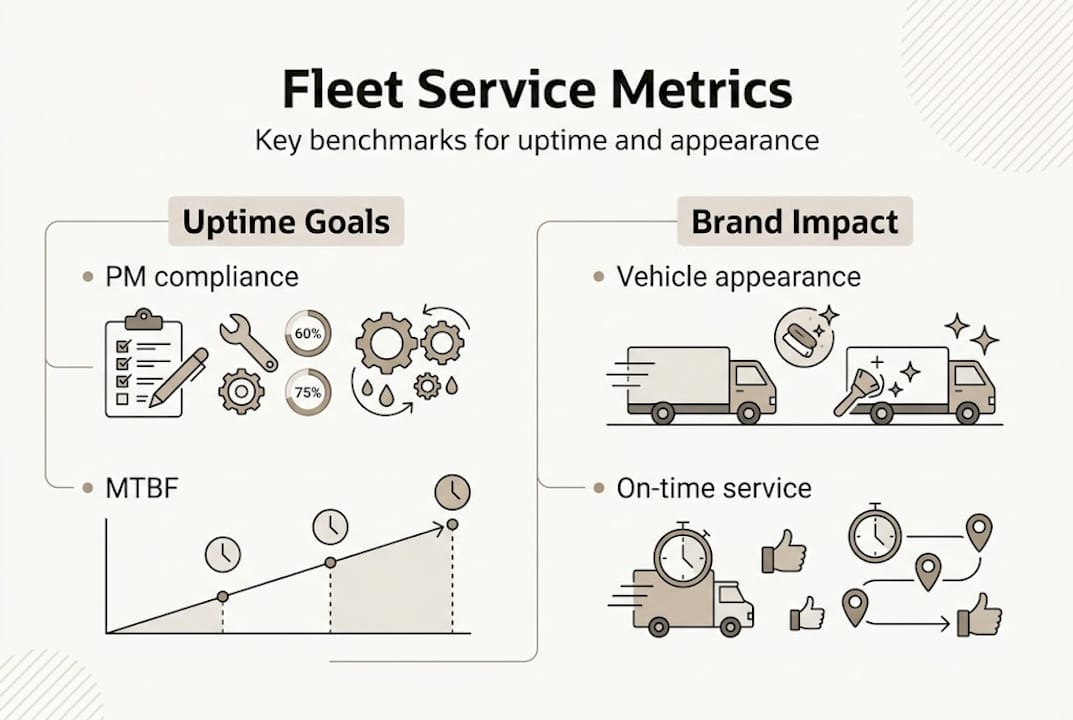
For South Jersey businesses, tracking these numbers doesn’t require a massive software investment. Even a well-organized spreadsheet updated weekly can reveal patterns that save thousands of dollars annually. The key insight is to start measuring. You can’t improve what you don’t track. Pairing benchmark monitoring with solid fleet maintenance basics gives you both the framework and the practical steps to close performance gaps fast.
Appearance and business image: why detailing matters
Once fleet performance is ensured, focusing on appearance brings tangible business benefits that many fleet managers chronically undervalue. Your vehicles don’t just move cargo — they move your brand through every neighborhood, commercial district, and customer parking lot in South Jersey.

Think about this: a potential client sees your company’s van parked outside a competitor’s building. If that van is dirty, scratched, and faded, they’ve formed an opinion about your business before you’ve said a word. Your fleet image strategies are as important as your marketing budget.
South Jersey presents specific environmental challenges for vehicle appearance:
- Road salt and brine: Used heavily during winter months, these chemicals accelerate paint oxidation and undercarriage corrosion
- Spring pollen: Thick yellow coating that, when left sitting, etches into clear coat over time
- Urban grime and soot: Especially in areas near highways and industrial zones around Camden and Gloucester counties
- Humidity and UV exposure: New Jersey summers generate intense UV radiation that fades paint and degrades rubber seals faster than in drier climates
Understanding the detailing advantages for commercial fleets goes beyond aesthetics. Regular professional detailing protects paint surfaces from these environmental attacks, extending the useful life of the vehicle finish and protecting resale value.
Industry practice shows that high-visibility fleets prioritize frequent detailing every 2 to 4 weeks to maintain appearance standards and protect vehicle investment.
Best practices for appearance management include scheduling both interior and exterior detailing on a consistent rotation, using paint protection film on high-wear areas like bumpers and door edges, applying ceramic coatings to reduce the frequency of washes needed, and keeping interiors clean enough that drivers feel proud to represent the brand.
Pro Tip: Schedule mobile detailing at your business location or dispatch lot overnight or during off-hours. Your vehicles never leave the property, downtime is zero, and your team shows up the next morning to a clean fleet ready to roll.
Special considerations for different fleet types
But not all fleets or vehicles have identical needs — some require truly specialized approaches that a one-size-fits-all service provider simply can’t deliver.
Specialized fleet needs vary significantly: heavy-duty fleets require robust upgrades like suspension reinforcements and lift kits, electric vehicles demand level 3 certified technicians with software diagnostic capability, and high-visibility branded fleets must prioritize consistent, frequent detailing to maintain their public-facing image. Each of these categories demands a different service approach and a different provider skillset.
Here’s how different fleet detailing types align with specific vehicle categories:
- Heavy-duty service trucks and construction vehicles: These vehicles accumulate heavy grease, industrial chemicals, and deep grime that standard detailing products can’t cut through. They need steam cleaning, degreasing agents, and undercarriage washing on a more aggressive schedule, often weekly.
- Delivery vans and branded vehicles: For businesses like HVAC companies, plumbers, and food delivery services in South Jersey, a spotless, uniformly branded van communicates professionalism. These vehicles need exterior detailing every two to three weeks at minimum, with special attention to door handles, bumpers, and decal edges.
- Electric vehicles (EVs): The EV fleet space is growing fast, and detailing EVs requires awareness of charging port seals, high-voltage component locations, and the specific paint types used by manufacturers like Tesla and Rivian. Not every detailer has this training.
- Sales and executive vehicles: These cars need showroom-quality results consistently. Leather conditioning, odor elimination, and paint correction treatments matter here far more than in a work truck.
- Agricultural and specialty vehicles: In South Jersey’s agricultural belt, farm equipment and work vehicles face extreme contamination from pesticides, fertilizers, and heavy soil. Specialized cleaning protocols are non-negotiable.
Pro Tip: When interviewing a mobile detailing provider for your fleet, ask specifically about their experience with your vehicle types. A provider who has detailed Tesla Model Ys and lifted Ford F-350s will give you very different results than someone who primarily handles passenger sedans.
Tailored scheduling is equally important. A delivery fleet that runs seven days a week needs a detailing provider who can work around dispatch schedules, ideally arriving before or after peak hours. Flexibility isn’t a luxury — it’s a baseline requirement for a serious commercial detailing partner.
Why business owners often underestimate the value of fleet service
Here’s an uncomfortable truth: most business owners treat fleet service as a cost center rather than a revenue protection strategy. They optimize for the cheapest monthly spend and ignore the compounding value of appearance, uptime, and benchmark performance.
The data tells a different story. Full-service leasing offers predictability but comes with higher costs, while unbundled management allows more control but increases administrative overhead — and larger fleets of 50 or more vehicles tend to favor leasing because the management complexity becomes unmanageable otherwise. This is a real operational tradeoff, not just a financial one.
What gets lost in this calculation is brand equity. A dirty, dented fleet tells customers that you cut corners. It tells potential employees that you don’t invest in your tools. It reduces trade-in and resale value, which affects your capital cycle every time you rotate vehicles. The ability to cut depreciation through consistent detailing is a real, measurable financial benefit that most operators ignore until they’re staring at a disappointing resale offer.
The businesses we see thriving in South Jersey are the ones that treat their fleet like a marketing asset, not just an operational necessity. They schedule detailing the same way they schedule oil changes: on a calendar, with accountability, and with a professional partner who knows their vehicles.
Mobile detailing: the simplest way to boost your fleet’s value
Knowing what works best, here’s how you can put these solutions into practice locally.
Everything covered above — benchmark monitoring, image management, specialized vehicle care — comes together when you partner with a mobile detailing provider who understands commercial fleets. CDC Auto Detailing brings professional-grade service directly to your South Jersey business location, whether you’re managing five vehicles or fifty.
Our fleet image services are customized to your vehicle types, schedule, and brand standards. Whether you need weekly visits for high-visibility delivery vans or monthly protection treatments for executive vehicles, we build a program around your operation. Explore the full range of fleet detailing solutions available, or book mobile detailing directly on our site to get started with zero hassle and maximum results.
Frequently asked questions
How often should commercial fleets be detailed?
High-visibility commercial fleets should be detailed every 2 to 4 weeks to maintain brand appearance and protect vehicle paint and surfaces from environmental damage.
What is preventive maintenance (PM) compliance and why is it important?
PM compliance measures how reliably your team completes scheduled maintenance tasks on time, and top fleet benchmarks call for 95% or higher to prevent costly breakdowns and unplanned downtime.
Are there different detailing needs for electric vehicles (EVs) and heavy-duty trucks in fleets?
Yes — EVs require level 3 certified technicians with software diagnostic training, while heavy-duty trucks benefit from degreasing, undercarriage washing, and more aggressive cleaning schedules.
What benchmarks matter most for fleet service performance?
The most critical metrics are PM compliance over 95%, MTBF between 20,000 and 30,000 miles, and unplanned downtime kept below 12 hours per vehicle each month.
What is the cost difference between full-service leasing and unbundled fleet management?
Full-service leasing delivers predictable monthly costs but at a premium price, while unbundled management reduces expenses but places the burden of vendor coordination and compliance tracking on your internal team.