
TL;DR:
- Unplanned vehicle downtime can cost U.S. fleet operators up to $760 per vehicle daily, risking significant profit loss from breakdowns. An effective fleet maintenance checklist based on standardized intervals, accountability, and real-world data reduces reactive repairs, improves safety, and ensures compliance. Implementing digital tools and fostering driver communication enhances record accuracy, predictive maintenance, and overall fleet longevity.
Unplanned vehicle downtime costs U.S. fleet operators between $448 and $760 per vehicle per day, which means a single breakdown across a ten-vehicle operation can erase a week’s worth of profit in 24 hours. A structured fleet maintenance checklist is not a back-office formality. It is the highest-return investment you can make in your operation, cutting reactive repair costs, keeping drivers safe, and protecting your compliance records before a DOT auditor ever shows up at your door. This guide gives you exactly that: a practical, checklist-driven framework built for fleet managers and business owners who cannot afford to wing it.
Table of Contents
- Key takeaways
- 1. What makes a fleet maintenance checklist effective
- 2. The 12-step fleet maintenance checklist
- 3. Checklist priorities at a glance
- 4. Practical tips for fleet managers implementing checklists
- My honest take on fleet maintenance discipline
- Keep your fleet looking as sharp as it runs
- FAQ
Key takeaways
| Point | Details |
|---|---|
| Downtime costs are severe | At up to $760 per vehicle per day, a preventive maintenance plan pays for itself after one avoided breakdown. |
| Schedule by mileage and usage | Use 5,000, 15,000, and 30,000-mile intervals as your baseline, then adjust with telematics data. |
| Brakes top the priority list | Brake failures cause the most commercial crash fatalities and the most DOT out-of-service violations. |
| Documentation is non-negotiable | Federal law under 49 CFR Part 396.3 requires dated service records with odometer readings on every vehicle. |
| Digital tools outperform paper | Telematics and digital logs create audit-ready records and flag real-world wear before mileage thresholds trigger. |
1. What makes a fleet maintenance checklist effective
Not all checklists are created equal. A checklist that simply lists “check tires” without frequency, responsible party, or pass/fail criteria is theater, not maintenance management. An effective fleet maintenance checklist is built around three pillars: standardized intervals, accountability, and real-world usage data.
Standard preventive maintenance intervals give you a reliable backbone:
- Every 5,000 miles: Oil and filter changes, fluid top-offs, visual leak inspections, and tire pressure checks
- Every 15,000 miles: Brake pad and lining inspection, air filter replacement, belt condition review, and battery load test
- Every 30,000 miles: Transmission fluid, coolant flush, serpentine belt replacement, and fuel filter service
These intervals are your floor, not your ceiling. Heavy-duty trucks pulling consistent loads, vehicles operating in extreme heat, and city delivery vans idling for hours each day all wear faster than mileage alone reflects. Telematics-based scheduling that factors in engine hours and actual usage patterns outperforms fixed mileage triggers every time. If your fleet runs telematics hardware, use it to drive your service schedule, not just track locations.
On the compliance side, 49 CFR Part 396.3 requires commercial fleets to maintain records that include the date of service and the odometer reading for every inspection and repair. Skipping this step does not just create legal exposure. It eliminates your ability to trend vehicle performance and catch patterns before they become breakdowns.
Pro Tip: Set calendar-based review meetings monthly to compare your telematics mileage data against your scheduled service triggers. Vehicles approaching intervals within 500 miles should be pre-booked before they hit the threshold, not after.
2. The 12-step fleet maintenance checklist
This is the core of your preventive maintenance plan. Walk each vehicle through these twelve systems at every scheduled inspection and document every finding, even when the result is “no action required.”
-
Engine system: Check oil level and color, inspect the oil filter for leaks, and look for coolant mixing or carbon buildup around the valve cover. A milky oil texture signals coolant intrusion before any warning light fires.
-
Transmission system: Verify fluid level and condition. Dark, burnt-smelling fluid indicates overdue service. On automatic transmissions, pan leaks and delayed shifts are early failure warnings that are cheap to address and expensive to ignore.
-
Brake system: Inspect lining thickness, drum and rotor condition, and air brake pressure if applicable. Brake failures are the leading cause of commercial vehicle crash fatalities and the number one DOT out-of-service violation. No other checklist item carries higher combined safety and compliance weight.
-
Steering and suspension: Check tie rod ends, ball joints, and steering play. On air-ride equipped trucks, listen for compressor cycling during inspection. Uneven tire wear is almost always a suspension story before it becomes a tire story.
-
Electrical system: Load-test the battery, inspect terminal corrosion, and check wiring harnesses for rodent damage or chafe points. A single failed alternator can leave a driver stranded mid-route with a full load.
-
Tires: Measure tread depth at three points across each tire, check inflation against the placard spec (not visual inspection), and log the last rotation date. Mismatched inflation across a drive axle pair on a truck accelerates wear and affects fuel economy.
-
Cooling and exhaust: Inspect hose condition, radiator cap seal, and coolant concentration. On the exhaust side, check for loose hangers and look for soot deposits around joints that indicate exhaust leaks before they affect cabin air quality.
-
HVAC and cabin air filter: A clogged cabin filter reduces airflow and driver comfort, which affects alertness on long routes. Replace on the 15,000-mile cycle or sooner in dusty environments.
-
Body, belts, and hoses: Inspect belts for cracking or glazing and hoses for softness, hardness, or swelling near clamps. Walk the body for damage that could admit water to electrical components or create aerodynamic drag.
-
Fluids: Power steering, brake, and windshield washer fluid levels should all be documented, not just topped off. Chronic low fluid levels point to leaks that need repair, not just refilling.
-
Safety equipment: Fire extinguishers and emergency warning devices must meet FMCSA specifications and be inspected regularly. Expired extinguisher tags or missing triangles can generate violations even when the vehicle is mechanically perfect.
-
Documentation and DVIR: Log every finding with date, mileage, technician name, and resolution status. The next driver must sign the DVIR acknowledging the repair certification review, a requirement that many fleet managers miss and that generates audit failures.
Pro Tip: Build a “no-defect” DVIR signature into your driver app workflow so that even clean inspections create a timestamp record. Auditors want evidence of a consistent process, not just evidence of repairs.
3. Checklist priorities at a glance
Use this table to allocate your time, budget, and attention across the twelve inspection areas.
| Checklist item | Safety impact | Cost prevention | Compliance requirement | Inspection frequency |
|---|---|---|---|---|
| Brake system | Critical | High | DOT/FMCSA required | Every 15,000 miles |
| Tires | Critical | High | State and federal regs | Every 5,000 miles |
| Engine oil and filter | Moderate | Very high | Record required | Every 5,000 miles |
| Electrical system | Moderate | High | None specific | Every 15,000 miles |
| Safety equipment | High | Low | FMCSA required | Every inspection |
| Transmission fluid | Moderate | High | Record required | Every 30,000 miles |
| Cooling system | Moderate | High | Record required | Every 30,000 miles |
| HVAC and cabin filter | Low | Moderate | None specific | Every 15,000 miles |
| DVIR documentation | N/A | Low | FMCSA required | Every trip |
| Body and structural | Low | Moderate | State-specific | Every 30,000 miles |
The right-hand column is your scheduling backbone. The safety and compliance columns tell you which items cannot be deferred without real risk. Budget cuts should never touch the brake, tire, or safety equipment rows.
4. Practical tips for fleet managers implementing checklists
Knowing what to check is only half the job. The other half is building a system where inspections actually happen, records stay clean, and your maintenance spend is always working for you.
Start by standardizing vehicle specs and parts suppliers across your fleet wherever possible. When every light-duty van in your operation uses the same oil filter and brake pad, your technicians train once and your parts inventory shrinks dramatically. This is one of the most underrated cost levers in fleet management, and it also speeds up every scheduled service event.
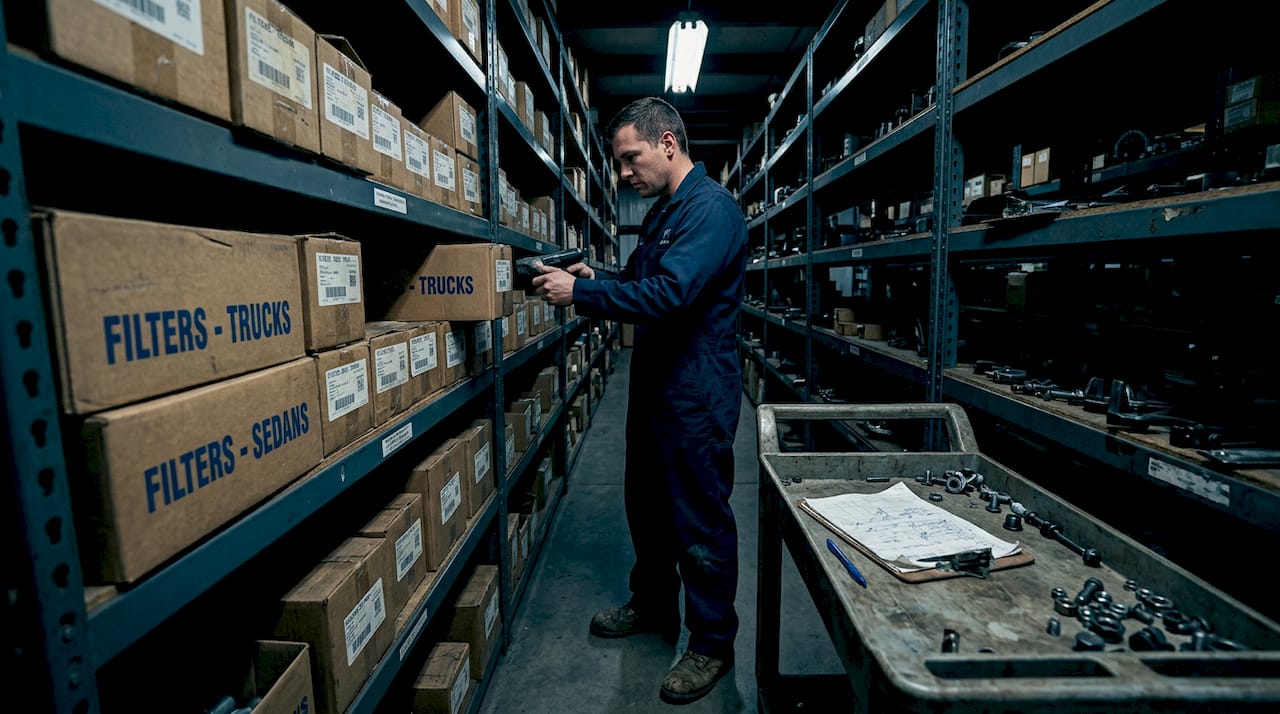
Assign clear inspection ownership. Drivers should complete pre- and post-trip checks. Technicians handle scheduled service. Fleet managers review documentation and flag overdue vehicles. Without named accountability at each stage, checklists become suggestions.
Warranty reimbursements are a real financial recovery tool that many operations leave on the table. When a component fails within its warranty period, documented service records are what make the claim stick. Track claims actively and follow up. A well-documented fleet history can recover thousands of dollars annually on a mid-size fleet.
For DOT audit readiness, keep records for a minimum of twelve months and ensure every repair entry includes the certifying technician’s signature. Digital systems that sync with your telematics platform make this automatic rather than manual.
Pro Tip: Build a monthly maintenance budget forecast using your telematics mileage projections. Compare actual spend to the forecast each month. Consistent overruns in a specific vehicle category usually point to a spec mismatch between vehicle and route demands.
Fleet dashcams and telematics also contribute directly to your maintenance schedule by identifying hard-braking events and excessive idling that accelerate component wear. When you know a vehicle has logged thirty hard-brake events in a week, you move the brake inspection forward rather than waiting for the calendar.
Finally, factor your commercial vehicle cleaning checklist into your overall fleet servicing guide. Clean vehicles are inspected more thoroughly, surface corrosion is spotted earlier, and drivers take more pride in well-maintained equipment.
My honest take on fleet maintenance discipline
I have worked with fleet operators across a wide range of industries, and the pattern I see most consistently is this: the managers who struggle most are not the ones who lack knowledge. They are the ones who know what to do but treat the checklist as an ideal rather than a non-negotiable standard.
Pushing service intervals is where this shows up most. I understand the pressure. A vehicle that is out for service is not generating revenue. But in my experience, every extra thousand miles you squeeze past an oil change interval costs you three to five times that savings in accelerated wear over the vehicle’s life. Top-performing fleet managers do not push intervals. Full stop.
The second underestimated factor is driver communication. Drivers see these vehicles every single day. A driver who understands why the pre-trip checklist matters and feels empowered to flag small issues without fear of being blamed is your earliest warning system. That relationship is free, and most fleet managers leave it completely undeveloped.
I am also watching how AI-powered maintenance tools are changing what “preventive” actually means. Predictive failure modeling based on real usage data is not a future concept. It is available today and genuinely useful. If your operation runs more than twenty vehicles, it is worth evaluating seriously. The checklist does not go away. It gets smarter.
— Charles
Keep your fleet looking as sharp as it runs
A thorough maintenance checklist keeps your vehicles running, but appearance matters just as much for client impressions and asset resale value. Cdcautodetailing offers mobile fleet detailing services across South Jersey that fit around your operations so vehicles get serviced without downtime disruption. From exterior washes and interior deep cleaning to ceramic coating protection that reduces paint wear and makes future cleaning faster, the services are built specifically for commercial fleets. Explore the full breakdown of fleet detailing options and schedule a consultation to see what a consistent appearance program adds to your overall fleet care strategy.
FAQ
What is fleet maintenance?
Fleet maintenance is the structured program of inspections, servicing, and repairs that keeps a group of commercial vehicles safe, legal, and operational. It includes everything from oil changes and brake inspections to compliance documentation and driver vehicle inspection reports.
How often should fleet vehicles be inspected?
Basic checks should happen every 5,000 miles, with brake and filter inspections every 15,000 miles and major fluid and belt services every 30,000 miles. High-use or heavy-load vehicles may need shorter intervals based on engine hours and telematics data.
What records are required for fleet compliance?
Under 49 CFR Part 396.3, commercial fleets must maintain dated maintenance records including the odometer reading at the time of each service. Driver vehicle inspection reports with technician and driver signatures are also required under FMCSA rules.
What is the most commonly failed DOT inspection item?
Brake system defects are the most frequent cause of DOT out-of-service violations for commercial vehicles. Regular brake inspections at every 15,000-mile interval are the single most important safety action on your checklist.
Can I use a digital system for fleet maintenance records?
Yes, and most compliance experts recommend it. Digital logs integrated with telematics platforms create automatic timestamps, flag overdue vehicles, and generate audit-ready documentation far more reliably than paper-based systems.