
TL;DR:
- Safety protocols ensure vehicle repairs are performed without damage or safety system failures.
- Professional shops and mobile detailers must follow detailed procedures for vehicle support and chemical management.
- Owners should ask providers about safety measures and verify adherence to OEM standards before service.
Most vehicle owners in South Jersey hand over their keys assuming every shop or mobile detailer follows the same rulebook. That assumption can be costly. A simple interior cleaning or paint correction job can go sideways fast when a technician skips a step, mishandles a chemical, or fails to secure the vehicle properly. The result? Scratched paint, a chemical burn on your upholstery, or worse, a safety system that no longer works correctly after a repair. This guide breaks down what real safety protocols look like, why they matter for your vehicle’s long-term health, and how to spot a provider who actually follows them.
Table of Contents
- Why safety protocols are the foundation of reliable auto care
- Inside the details: What makes a shop or technician truly safe?
- How preventive maintenance and inspections protect your safety (and wallet)
- Risks when safety protocols are ignored: What vehicle owners need to know
- Our view: Why South Jersey vehicle owners can’t afford shortcuts on safety
- Get protocol-driven care with South Jersey’s trusted experts
- Frequently asked questions
Key Takeaways
| Point | Details |
|---|---|
| Protocols prevent risks | Following safety protocols is crucial for preventing accidents, injuries, and costly repairs in auto care. |
| Quality reveals itself in details | A shop or mobile service that adheres to thorough protocols delivers more reliable, long-lasting results for your vehicle. |
| Regular checks save money | Routine safety inspections and maintenance lower breakdown risks and help preserve your vehicle’s value. |
| Demand full transparency | Always ask about safety standards and don’t trust providers who cut corners or downplay essential protocols. |
Why safety protocols are the foundation of reliable auto care
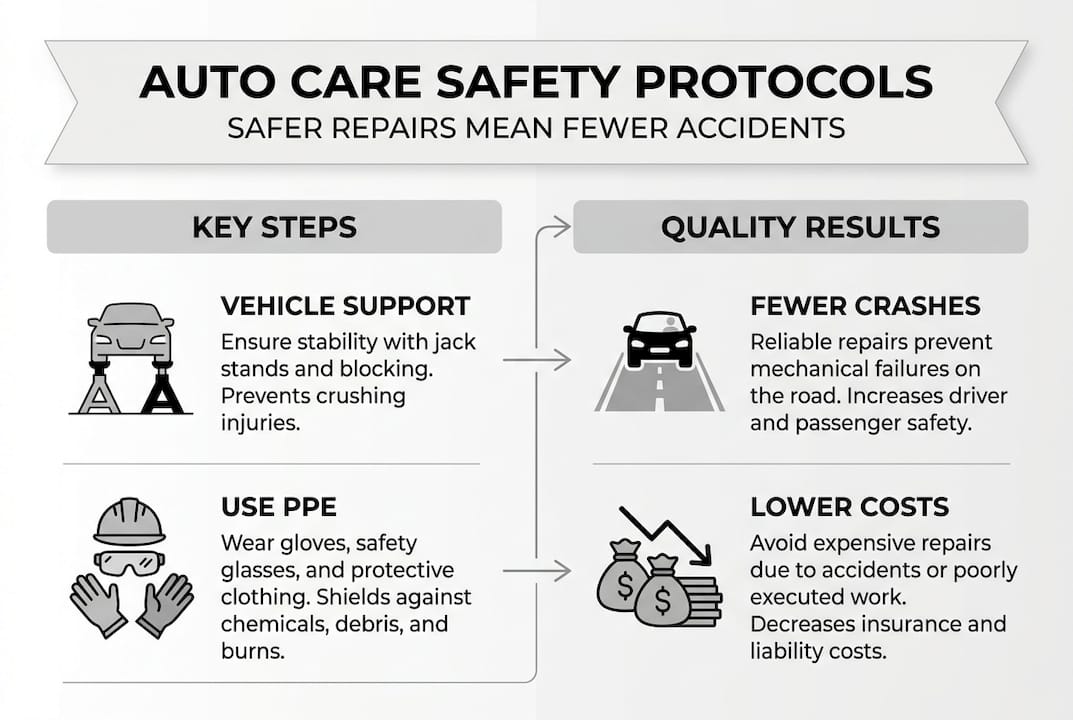
Safety protocols are not just paperwork or bureaucratic checkboxes. They are a defined set of procedures that every professional auto care technician should follow before, during, and after working on your vehicle. These include using personal protective equipment (PPE) like gloves and eye protection, ensuring vehicles are securely supported during any elevated work, managing chemical hazards properly, and running regular equipment checks before each job.
Why does this matter to you as a vehicle owner? Because when these steps are skipped, the consequences are not always visible right away. A chemical applied without proper dilution can degrade your clear coat over weeks. A vehicle that was not properly secured during a lift could shift and cause damage that is not discovered until your next oil change.
Safety protocols in auto care primarily prevent accidents during repairs by ensuring vehicles are securely supported, using PPE, managing chemical and fire hazards, and conducting regular inspections. That foundation directly translates to better outcomes for your vehicle.
Here is what a real safety protocol checklist covers:
- PPE usage: Gloves, eye protection, and appropriate clothing for every job
- Vehicle support: Chocks, axle stands, and lift locks before any undercarriage work
- Chemical management: Proper dilution, storage, and disposal of all detailing products
- Equipment inspection: Checking tools and machines before each use
- Emergency readiness: Fire extinguishers, first aid kits, and clear exit paths on site
“A safety culture is not built in a day. It is built one job at a time, by technicians who treat every vehicle like it belongs to someone they care about.”
The myth that all shops and mobile services apply these protocols equally is widespread. Reality tells a different story. Understanding why safety protocols are crucial can help you make smarter choices about who works on your vehicle. When protecting clients and techs is a priority, the quality of the work reflects it. And when detailing protocols protect your car, you feel the difference in how your vehicle looks, performs, and holds its value over time. That connection between safety and quality is what separates truly professional services from the rest, especially when it comes to detailing and vehicle safety in South Jersey.
Inside the details: What makes a shop or technician truly safe?
Knowing protocols are foundational, let’s inspect how real-world auto shops and mobile detailers apply these standards, and how you can spot best-in-class service.
A professional technician does not just show up with a bucket and a buffer. They arrive with a system. Here is what that system looks like in practice:
- Wheel chocking and vehicle support before any lift or undercarriage access
- PPE selection based on the specific chemicals and tools being used
- Hazard communication using Safety Data Sheets (SDS) for every product on the job
- Lockout and tagout procedures for any electrical system work
- Proper ventilation when working with solvents, coatings, or aerosols
- Clear signage around the work area to prevent accidents
Key safety mechanics include chocking wheels, using axle stands with jacks, engaging lift locks, hazard communication via SDS, lockout/tagout for electrical work, and proper ventilation. These are not optional extras. They are the baseline for any competent operation.
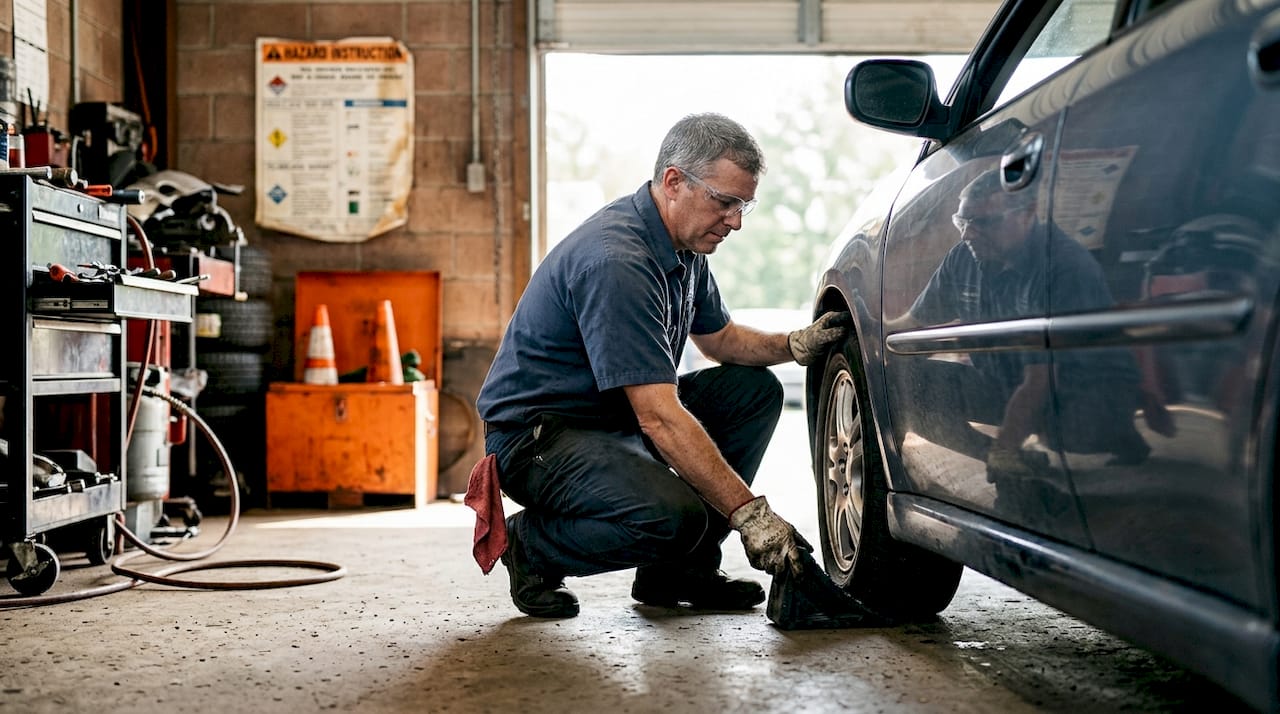
One important distinction worth knowing: mobile detailers face unique challenges that shop-based technicians do not. Working in a driveway, a parking lot, or a fleet yard means the environment changes every single time. Lighting, surface stability, and access to water and power all vary. A truly professional mobile detailer plans for these variables rather than improvising around them.
| Safety factor | Shop-based service | Mobile detailing service |
|---|---|---|
| Vehicle support | Fixed lifts with locks | Portable stands and chocks |
| Chemical storage | Climate-controlled storage | Insulated transport containers |
| Ventilation control | Built-in ventilation systems | Relies on outdoor conditions |
| Equipment inspection | Daily pre-shift checks | Per-job equipment review |
| ADAS calibration | Controlled indoor environment | Outdoor accuracy varies |
For car detailing safety tips that apply whether you are at a shop or using a mobile service, the core principle is the same: ask questions before the work starts.
Pro Tip: Before any technician touches your vehicle, ask them to walk you through their safety checklist. A professional will answer without hesitation. Hesitation itself is a red flag.
How preventive maintenance and inspections protect your safety (and wallet)
Understanding the tools and protocols is key, but it is regular maintenance and inspections where safety pays real dividends for drivers and their wallets.
The numbers are hard to argue with. Fleets with preventive programs see 35 to 75% crash reduction, poor maintenance is linked to 65% higher crash risk, and regular inspections cut breakdowns by 38%. These statistics apply just as much to individual vehicle owners as they do to commercial fleets.
Key stat: Protocol-following fleets see up to 75% fewer crashes compared to those without structured maintenance programs.
Think about what that means for your personal vehicle. Neglected brakes, worn tires, and overdue inspections are not just inconveniences. They are accidents waiting to happen. A professional detailer who follows strict protocols will often catch these warning signs during a service visit, even when the primary job is cosmetic.
Here is what consistent, protocol-driven care does for your vehicle:
- Fewer unexpected repairs: Catching small issues before they become expensive ones
- Improved resale value: A well-maintained vehicle commands a stronger price
- Safer daily driving: Properly functioning systems keep you and others on the road safe
- Longer vehicle life: Consistent care extends the lifespan of paint, interior surfaces, and mechanical components
| Maintenance behavior | Crash risk impact | Breakdown frequency |
|---|---|---|
| Regular inspections | Up to 75% lower | 38% fewer incidents |
| No structured program | 65% higher risk | Significantly more frequent |
| Reactive-only maintenance | Moderate risk | Unpredictable |
For individual owners, the logic mirrors fleet management. You can preserve vehicle value with maintenance by treating every detailing appointment as part of a broader care strategy. Watch for signs your fleet needs maintenance if you manage multiple vehicles, and explore the broader detailing benefits for fleets to understand how professional protocols scale across any number of vehicles.
Risks when safety protocols are ignored: What vehicle owners need to know
Even with the right information, some shops still skip steps. Here is how that can go dangerously wrong, and how you can steer clear.
Inadequate vehicle support causes the majority of serious injuries during repairs. Tire explosions during inflation, ADAS miscalibration that disables automatic emergency braking, and outdoor mobile calibration that produces inaccurate results are all real risks when protocols are not followed. These are not theoretical edge cases. They happen when technicians rush or cut corners.
OEM (original equipment manufacturer) standards exist for a reason. When a shop deviates from them, particularly on safety-critical systems, the consequences can be invisible until they are not. A miscalibrated lane departure system or a poorly reset tire pressure monitor can fail you at exactly the wrong moment.
OEM standards are essential for safety, especially for full ADAS calibration, but some shops and mobile services cut corners. DIY repairs on brakes or tires are particularly risky, and professional maintenance is always the safer path.
Here is how to spot a provider who is cutting corners:
- No visible PPE during chemical application or paint work
- Vague answers when you ask about their safety procedures
- No SDS documentation for the products they use
- Skipping calibration steps after windshield or sensor-related work
- Rushed timelines that do not allow for proper inspection steps
- No written process for handling chemical spills or equipment failures
“A shop that cannot explain its safety process has not built one. Walk away before they demonstrate that fact on your vehicle.”
When detailing protocols protect your car, you are not just paying for a clean vehicle. You are paying for the peace of mind that comes from knowing every step was done correctly.
Pro Tip: After any repair involving sensors, cameras, or windshield replacement, always ask directly whether full ADAS calibration was completed. Do not assume it was included.
Our view: Why South Jersey vehicle owners can’t afford shortcuts on safety
With the risks laid bare, here is our take as experienced South Jersey detailers on how local vehicle owners can confidently demand and receive the highest safety standards.
Here is something most articles will not tell you: the most dangerous shortcuts in auto care are the ones you never see. A technician who skips a calibration step or uses an improperly diluted chemical does not leave obvious evidence. The damage shows up later, sometimes much later, and by then it is harder to trace back to the source.
Many mobile services can match or exceed the safety standards of a fixed shop, but only when they bring the right equipment, follow full protocols, and adapt their process to the environment they are working in. The difference between a great mobile detailer and a risky one is not the truck they drive. It is the process they follow.
We believe vehicle owners in South Jersey should ask direct questions before booking anyone. What products do you use? How do you handle chemical spills? Do you carry SDS sheets? These are not rude questions. They are the right ones. Learn more about detailing safety in South Jersey and use that knowledge to hold every provider accountable. Real savings come from doing it right the first time.
Get protocol-driven care with South Jersey’s trusted experts
Ready to put safety and quality first? Here is how you can take the next step to guarantee protocol-backed auto care for your vehicle.
At CDC Auto Detailing, every service we provide is built around strict safety-first detailing protocols that protect your vehicle and give you total confidence in the results. We do not improvise. We follow a documented process on every job, whether we are working on a single car in your driveway or a full commercial fleet.
Explore our full range of auto detailing service examples to see exactly what protocol-driven care looks like in practice. When you are ready to schedule, book mobile detailing directly through our site and get professional, safety-focused service brought right to your location across South Jersey.
Frequently asked questions
What are the key safety protocols in auto detailing services?
Key protocols include using proper PPE, securing vehicles with chocks and stands, managing chemicals safely with SDS documentation, and following detailed inspection checklists before and after every job.
How do safety protocols reduce accidents during auto repairs?
They prevent accidents by ensuring vehicles are stable, reducing chemical and fire risks, and providing clear step-by-step procedures. Proper vehicle support alone eliminates one of the most common causes of serious repair-related injuries.
Is mobile detailing as safe as shop-based auto care?
Mobile detailing can be just as safe when technicians bring all necessary equipment and follow full protocols. The key risk area is outdoor ADAS calibration, which requires extra care in uncontrolled environments.
How can I tell if my auto care provider follows the right safety protocols?
Ask direct questions about their safety steps, look for visible equipment and SDS sheets, and check whether they follow OEM calibration standards. Transparency is the clearest sign of a trustworthy provider.