

For most commercial fleets in the United States, onsite mobile fleet washing is the right default choice. It eliminates vehicle downtime from off-site trips, adapts to your yard schedule, and, when the provider runs a closed-loop water reclamation system, keeps you compliant with local zero-discharge rules without any extra coordination on your end. The one scenario where a fixed-location truck wash makes more sense: high-volume long-haul operations where throughput speed matters more than scheduling flexibility and vehicles pass a wash bay on their regular route anyway. A hybrid program, combining scheduled fixed-site bulk washes with mobile touch-ups, works well for mixed fleets that need both.
Two factors make this comparison more consequential than most fleet managers expect: environmental compliance and total cost of ownership. The Clean Water Act and municipal zero-discharge ordinances apply to wash water that reaches storm drains, and fines for a single violation can be substantial. Cdcautodetailing’s mobile fleet program in South Jersey is built around both.
Table of Contents
- What are the main commercial fleet cleaning service types?
- How do the main service types compare side by side?
- What does fleet cleaning actually cost, and what contract terms matter?
- How do you evaluate and choose the right provider?
- What services and equipment should you expect?
- Which service type fits your fleet’s situation?
- Why Cdcautodetailing is the recommended mobile fleet option for South Jersey
- Key Takeaways
- The part most fleet managers skip until it costs them
- Cdcautodetailing fleet packages: get a site assessment this week
- Useful sources for fleet managers
What are the main commercial fleet cleaning service types?
Understanding the categories before you compare pricing or schedules saves a lot of back-and-forth with vendors.
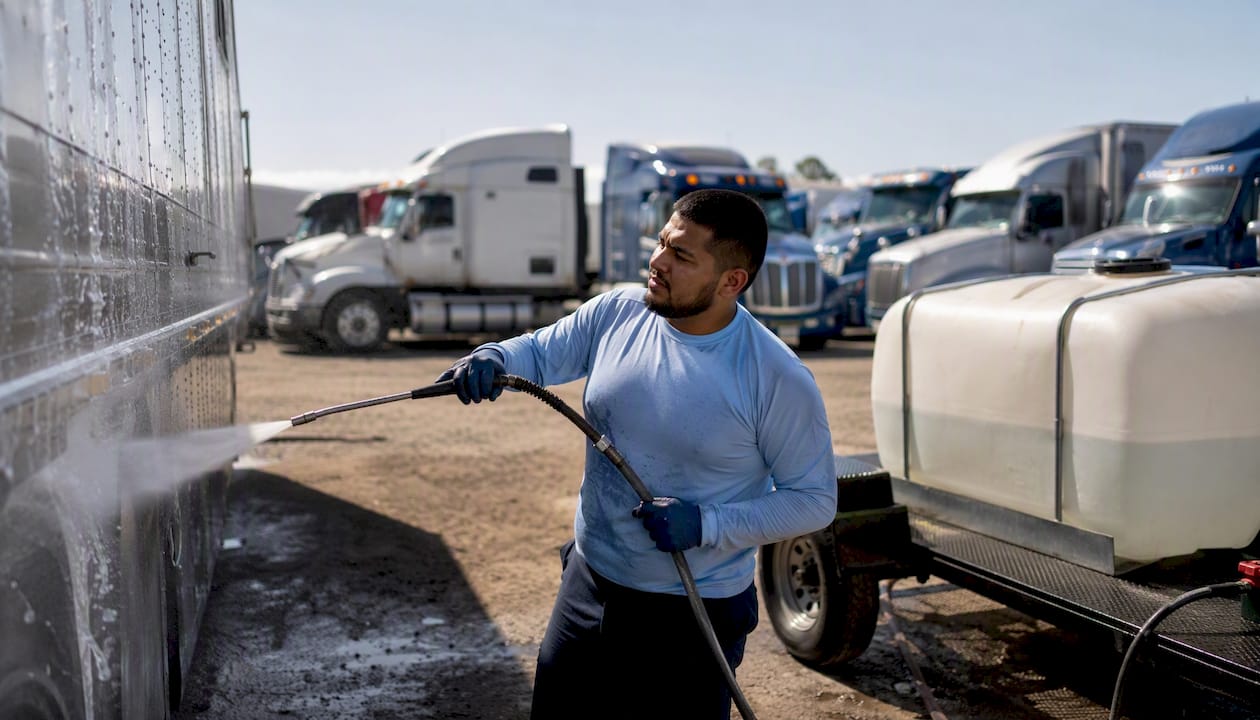
Mobile onsite fleet washing brings the equipment to your yard or depot. A technician or crew arrives with a truck-mounted pressure washer, water tanks, and (in compliant setups) a water reclamation system. No vehicle leaves the property. Scheduling wraps around your dispatch window.
Fixed-location commercial truck washes are drive-through or bay-style facilities, usually positioned near highway corridors. Throughput is their strength: a single bay can process dozens of vehicles per shift. The trade-off is that someone has to drive each vehicle there and back.
Contract detailing providers go beyond a basic wash. They handle interior cleaning, degreasing, engine compartment work, and protective coatings. Pricing is typically per-vehicle or per-site on a recurring schedule. Commercial vehicle detailing at this level is what separates a clean fleet from a well-maintained one.
Hybrid programs combine scheduled fixed-site bulk washes (usually weekly or bi-weekly) with mobile visits for spot cleaning, interior work, or vehicles that can’t leave the yard. For mixed fleets, this often delivers the best per-vehicle cost.
Regulatory note: Mobile washing in many U.S. jurisdictions falls under municipal zero-discharge rules. Fixed sites are typically permitted facilities with built-in wastewater treatment. Always confirm which category applies in your operating area before signing a contract.
How do the main service types compare side by side?
| Dimension | Mobile onsite | Fixed truck wash | Contract detailing | Hybrid program |
|---|---|---|---|---|
| Cost per vehicle | Moderate; lower TCO with no driver time | Low per wash; add driver time and fuel | Higher per visit; best long-term asset value | Moderate; bulk wash rate plus mobile premium |
| Scheduling | Fully flexible; fits your dispatch window | Fixed hours; vehicle must travel | Scheduled recurring; customizable | Split schedule; requires coordination |
| Service scope | Exterior, undercarriage, interior, degreasing | Exterior wash only (most sites) | Full scope: exterior, interior, engine, coatings | Full scope across both formats |
| Turnaround | 20 min per vehicle onsite | 5–15 min per vehicle at bay | 1–3 hours per vehicle depending on scope | Varies by component |
| Environmental compliance | Requires closed-loop water capture; provider-dependent | Permitted facility; built-in treatment | Provider must document wastewater handling | Depends on mobile component |
| Geographic coverage | Limited to provider’s service radius | Fixed locations; route-dependent | Regional or local; varies by provider | Depends on both components |
| Guarantees / SLA / insurance | Varies; request COI and rework policy | Minimal; typically no SLA | 100% satisfaction guarantee standard among top providers | Depends on contract terms |
| Equipment & quality | Industrial pressure washers; quality varies by provider | High throughput; limited detailing | Hot-water systems, reclamation, biodegradable detergents | Combination of both |
| Best fit | Urban/suburban fleets, delivery, municipal | Long-haul, highway-corridor fleets | Any fleet prioritizing asset preservation | Mixed fleets, 20+ vehicles |
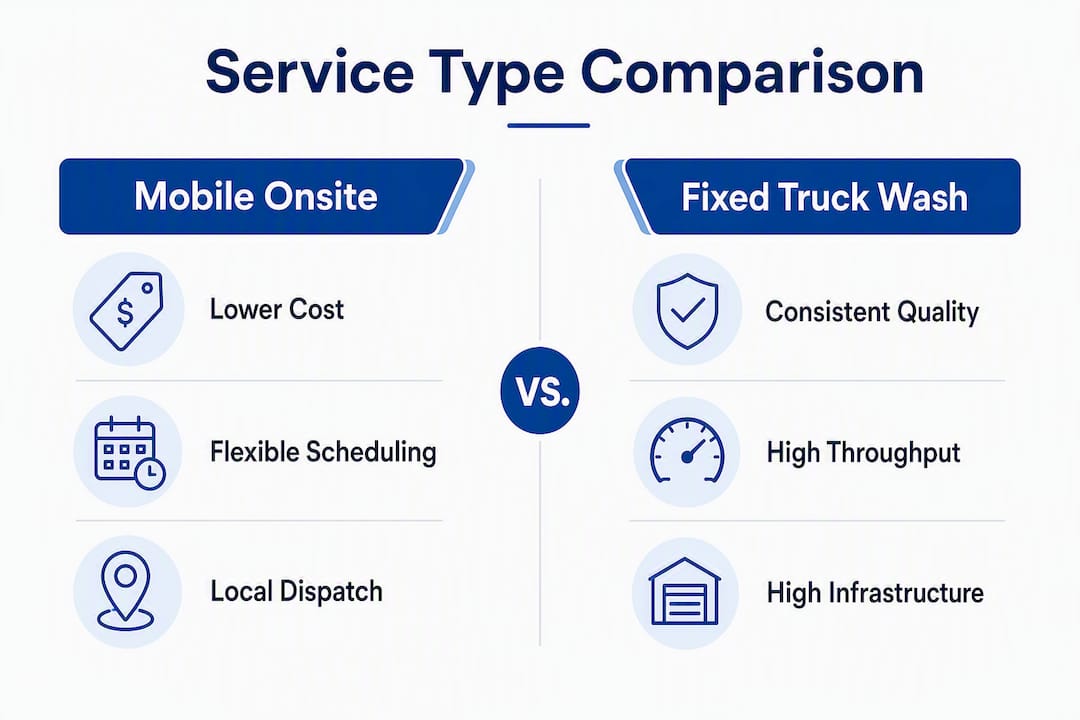
Local providers can match national providers on equipment quality while offering faster response times and better regional knowledge. National providers deliver standardized protocols, but their centralized dispatch often means slower scheduling adjustments when your routes change.
What does fleet cleaning actually cost, and what contract terms matter?
Pricing in this category is less standardized than most fleet managers expect. Consumer-grade mobile detailing benchmarks from Housecall Pro show basic packages running roughly $50–$120 per vehicle, standard packages $100–$200, and premium packages $200–$400. Commercial and heavy-duty vehicles push those numbers higher because of vehicle size, grease load, and the time required for undercarriage and engine work. A recurring contract for a fleet of 10–20 vehicles typically negotiates a lower per-vehicle rate in exchange for volume and schedule commitment.
The contract structure matters as much as the headline rate. Common models:
- Per-vehicle recurring: A fixed price per wash per vehicle, billed monthly. Predictable and easy to audit.
- Per-site flat fee: One price covers all vehicles at a location per visit. Works well when fleet size at a given yard is consistent.
- Per-wash packages: Prepaid blocks of washes at a discounted rate. Watch for expiration clauses.
Hidden costs are where proposals diverge. Industry reporting points to roughly a 10% difference between transparent local pricing and national contract billing once administrative fees and fuel surcharges are included. Always request a fully loaded monthly cost estimate, not just the per-vehicle rate.
Red flags in contract language:
- Auto-renewal clauses with 60-day or longer notice windows
- Fuel surcharges not capped or defined
- Minimum vehicle counts that exceed your actual fleet size
- Termination fees that exceed two months of service value
Timeline expectations are straightforward for planning purposes. A mobile crew typically handles 8–15 vehicles per half-day stop depending on service scope. A basic exterior wash at a fixed bay runs 5–15 minutes per vehicle. Full interior and exterior detailing with degreasing takes 1–3 hours per vehicle, so scheduling that work overnight or on weekends protects daytime operations.
Pro Tip: Ask every vendor for a sample invoice from an existing client of similar fleet size. The line items on a real invoice reveal surcharges and minimums that never appear in a proposal.
How do you evaluate and choose the right provider?
A structured evaluation process protects you from the two most common mistakes: choosing on price alone and skipping compliance verification. Work through these steps before signing anything.
- Conduct a site assessment. Walk the vendor through your yard, vehicle types, and access constraints. A provider who shows up without asking about vehicle height, surface drainage, or power access is not ready to serve a commercial account.
- Request a certificate of insurance (COI). General liability and commercial auto coverage are non-negotiable. Enterprise providers issue COIs rapidly as a standard part of onboarding; any hesitation here is a red flag.
- Verify environmental permits and water recovery specs. Ask specifically: does the mobile unit use a closed-loop reclamation system? Can they provide documentation? In jurisdictions with zero-discharge rules, this is a compliance requirement, not a preference.
- Check technician training and product certifications. Biodegradable detergents and proper pressure settings for painted surfaces matter for fleet asset preservation.
- Confirm SLA and response windows. What is the guaranteed response time if a scheduled visit is missed? Local dispatchers typically have better regional knowledge and faster response than centralized call centers.
- Request photo before/after documentation. Technology-enabled reporting materially reduces disputes about missed tasks and improves accountability across multi-site fleets. If a provider doesn’t offer digital reporting, ask why.
- Ask for references from comparable fleet accounts. Specifically ask those references about missed visits, billing disputes, and how the provider handled a compliance issue.
- Review the satisfaction guarantee terms. Industry experts recommend prioritizing providers that offer a 100% satisfaction guarantee so missed tasks are corrected at no charge. Get the rework policy in writing.
Walk away if: the provider has no COI, no documented wastewater solution, vague or verbal-only SLAs, or a centralized call center with no local dispatcher for your region.
What services and equipment should you expect?
A credible commercial fleet cleaning provider covers more than a basic rinse. The types of fleet detailing a full-service program should include:
Exterior services: pressure washing (typically 1,500–3,000 PSI for most commercial vehicles), foam application, hand wash, wheel and tire cleaning, undercarriage degreasing, and window cleaning.
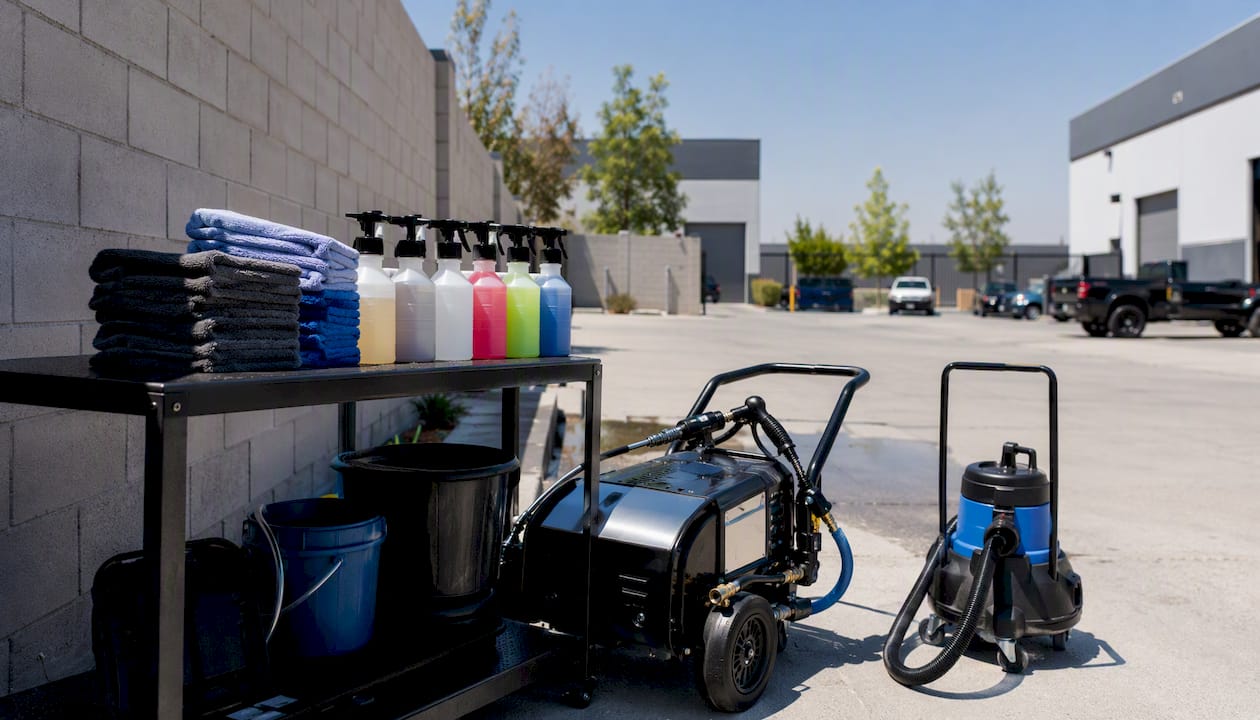
Interior services: vacuuming, surface wipe-down, door jamb cleaning, dashboard and console treatment, and disinfecting for passenger or food-service vehicles.
Specialized services: engine degreasing, fleet ceramic coating for paint protection and easier future cleaning, paint protection film for high-impact areas, and odor elimination for refrigerated or service vehicles.
Equipment that separates serious providers from basic wash crews: hot-water pressure systems (more effective on grease and road film than cold-water units), closed-loop water reclamation systems, transportable water tanks for sites without direct water access, and biodegradable or pH-neutral detergents that comply with municipal discharge rules.
On the compliance side, Portland’s pressure washing rules are a useful benchmark for what strict municipal zero-discharge enforcement looks like. Oregon DEQ’s guidance on wash activities similarly requires that wash water not reach storm drains. Many U.S. cities apply equivalent standards. Request the provider’s written compliance procedure and proof that their reclamation system meets local specs before the first visit.
Which service type fits your fleet’s situation?
The right answer depends on your fleet’s operating profile, not just vehicle count.
- Small urban delivery fleets (5–20 vehicles, daily routes): Mobile onsite is almost always the right call. Vehicles stay in the yard, no driver time is lost, and a local provider can schedule around your morning dispatch. Scheduling fleet detailing efficiently is the primary lever for minimizing operational disruption.
- Long-haul refrigerated trailers: Fixed-site washes near highway corridors make sense here. Drivers can run a truck through a bay during a mandatory rest stop. Interior disinfecting for food-service trailers should be a separate contracted service.
- Construction and aggregate fleets: Heavy mud, concrete, and chemical contamination require hot-water systems and strong degreasers. Mobile providers with industrial-grade equipment are preferable; most fixed bays aren’t equipped for this load.
- Municipal fleets: Compliance documentation is often a procurement requirement. Providers must supply COIs, wastewater compliance records, and sometimes union-labor certifications. A contract detailing provider with documented onboarding is the strongest fit.
- Mixed-use regional fleets (20+ vehicles, multiple vehicle types): A hybrid program, with bulk fixed-site washes for standard vehicles and mobile visits for oversized or specialty units, typically delivers the best combination of cost and coverage. Corporate account structures can simplify billing across multiple service vendors for fleets managing several maintenance relationships.
Operational constraints to check before committing: yard drainage and surface type (affects wastewater capture), vehicle height and width limits at fixed-site bays, water supply availability for mobile providers, and security requirements for after-hours access.
Why Cdcautodetailing is the recommended mobile fleet option for South Jersey
Cdcautodetailing operates as a fully mobile fleet cleaning and detailing service out of Pitman, New Jersey, covering South Jersey fleets that need onsite service without the overhead of a fixed-site contract. The program is insured and bonded, and the team issues certificates of insurance as a standard part of commercial account onboarding.
The service scope goes well beyond a basic wash. Fleet accounts can access exterior pressure washing, interior cleaning, engine degreasing, undercarriage treatment, and protective services including ceramic coatings that reduce cleaning time on future visits and protect paint from road chemicals. For fleets focused on long-term asset value, ceramic coating applied at the fleet level is one of the highest-ROI investments available.
Scheduling is handled locally. There is no centralized call center routing your request through a national queue. Local dispatch means faster response when a route changes or a vehicle needs an unscheduled visit. Cdcautodetailing’s 100% satisfaction approach means any missed or substandard work is corrected at no additional charge.
For fleet managers who want to verify fit before committing to a full contract, a pilot program covering a subset of vehicles is the practical starting point. The step-by-step fleet cleaning guide on the Cdcautodetailing site walks through what to expect from site assessment through first service.
Key Takeaways
Mobile onsite fleet washing delivers the best combination of operational flexibility, compliance control, and total cost of ownership for most U.S. commercial fleets, provided the provider runs a closed-loop water reclamation system and issues a COI.
| Point | Details |
|---|---|
| Mobile is the default choice | Onsite mobile washing eliminates driver downtime and fits your dispatch schedule for most fleet types. |
| Compliance is non-negotiable | Zero-discharge violations can incur substantial fines; always verify closed-loop reclamation before signing. |
| Hidden fees inflate national contracts | Administrative and fuel surcharges can add roughly 10% to billed costs; request a fully loaded monthly estimate. |
| Guarantees and SLAs belong in writing | A 100% satisfaction guarantee with a documented rework policy is the standard among top-rated commercial cleaners. |
| Cdcautodetailing for South Jersey fleets | Cdcautodetailing offers insured, locally dispatched mobile fleet cleaning with full-scope services and a satisfaction guarantee. |
The part most fleet managers skip until it costs them
The compliance question is where I see the most avoidable risk in fleet cleaning decisions. Managers spend real time comparing per-vehicle rates and scheduling windows, then sign a contract without ever asking whether the provider’s mobile unit captures wash water. That single gap can turn a $300 service visit into a five-figure regulatory fine.
The other underrated factor is local dispatch. A national provider’s standardized protocol sounds reassuring on paper. In practice, when your route changes on a Tuesday and you need to reschedule a 15-vehicle stop, a centralized call center adds friction that a local dispatcher eliminates in one phone call. The local knowledge advantage is real and it compounds over a 12-month contract.
My practical recommendation: before you evaluate any provider on price, run them through two questions. First, show me your water reclamation system documentation. Second, who is my local point of contact and what is their direct number? If either answer is vague, keep looking.
Cdcautodetailing fleet packages: get a site assessment this week
Fleet managers in South Jersey who want onsite cleaning without the compliance risk or scheduling friction of a national contract have a direct option. Cdcautodetailing brings industrial-grade mobile equipment to your yard, handles wastewater responsibly, and backs every visit with a satisfaction guarantee.
The practical next step is a no-obligation site assessment. Cdcautodetailing’s team reviews your vehicle types, yard layout, and scheduling requirements, then builds a per-vehicle or per-site proposal with fully transparent pricing. No fuel surcharges buried in the fine print, no centralized queue for scheduling changes. For fleets considering protective services alongside regular cleaning, the mobile detailing implementation guide covers exactly how a pilot program runs from first visit to full contract. Contact Cdcautodetailing to schedule your site assessment and request your COI documentation before the next service cycle.
Useful sources for fleet managers
- Portland Bureau of Environmental Services: Pressure Washing Rules — Municipal zero-discharge enforcement guidance; useful benchmark for understanding what strict compliance looks like in practice.
- Oregon DEQ: Wash Activities Guidance (PDF) — State-level documentation requirements for wash water management; helpful when drafting compliance language for vendor contracts.
- Cdcautodetailing: Fleet Vehicle Cleaning Guide for Managers — Practical scheduling and regulatory reference for South Jersey fleet programs.
- Cdcautodetailing: Fleet Cleaning vs. Individual Detailing — Cost and quality breakdown for managers deciding between program-level and one-off service.
- Dent Erasers LLC: Fleet Dent Repair in Contra Costa County — Fleet cosmetic maintenance reference for managers bundling vehicle-care vendors.
- Cdcautodetailing: 7 Key Types of Fleet Detailing for Managers — Service catalog breakdown for selecting the right detailing scope by vehicle type.