
Expect $80 to $350 for an exterior wash, $120 to $450 for interior cleaning, and $200 to $800 for full-service detailing on a single tractor. Add a trailer, a sleeper cab, or a mobile technician who has to drive to your yard, and the number climbs from there.
Here’s how that breaks down in practice:
- Basic exterior wash (day cab, tractor only): $80 to $180
- Mid-range service (exterior wash plus interior cleaning): $250 to $500
- Premium full detail (tractor plus trailer, undercarriage, engine bay): $500 to $800+
Pro Tip: Mobile, on-site detailing typically starts higher, often $250 to $550 for a full-service job, because you’re paying for the technician’s drive time and equipment setup instead of them working out of a fixed facility. That’s not a markup for convenience. It’s the actual cost of bringing a pressure washer, water tank, and detailing gear to your lot instead of you driving to them.
Key Takeaways
Semi truck detailing cost depends on scope, cab type, and location, but a full detail on a single tractor typically lands between $200 and $800.
| Point | Details |
|---|---|
| Exterior wash baseline | Expect $80 to $350 depending on soil level and truck size. |
| Full-service detail range | Budget $200 to $800 for a tractor; add more for trailer washouts. |
| Winter frequency increases cost | Northern routes often need several washes a month versus fewer in summer. |
| Ask before you book | Confirm scope, wastewater handling, insurance, and turnaround in writing. |
| Cdcautodetailing option | Offers mobile fleet and individual truck detailing across South Jersey with upfront scope discussion. |
Table of Contents
- What Drives Semi Truck Detailing Cost Line by Line
- What’s Actually Included in a Semi Truck Detail Package
- Why Do Semi Truck Detailing Quotes Vary So Much?
- How Much Should You Budget for Semi Truck Detailing Per Year?
- What Should You Ask Before Booking a Semi Truck Wash?
- Why Professional Detailing Pays for Itself
- The Gap Between Cheap Quotes and Real Value
- Book a Straightforward Semi Truck Detail With Cdcautodetailing
- Sources
What Drives Semi Truck Detailing Cost Line by Line
Every quote you get is really a stack of smaller line items, and knowing what each one costs helps you spot a fair price from an inflated one.
An exterior wash alone runs $80 low, $180 average, and up to $350 on the high end, depending on soil level, truck size, and whether it includes tires and wheels. Interior cleaning for the cab and sleeper falls between $120 and $450, and labor tends to dominate this line item more than any product cost. A sleeper cab with bunk cleaning, steam sanitization, and upholstery work eats hours, not minutes, which is why interior pricing scales closer to an hourly rate than a flat fee.
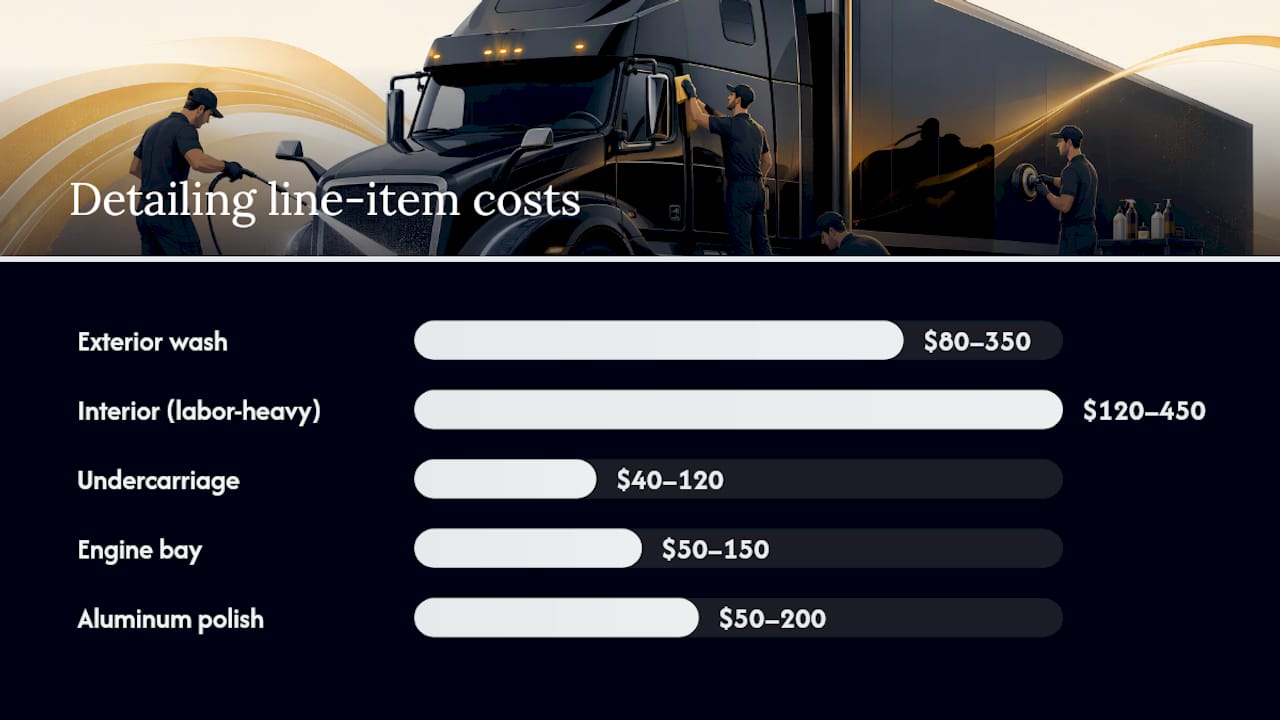
Undercarriage cleaning usually adds $40 to $120 depending on how much road grime, salt, or brake dust has built up. Engine bay detailing runs a similar range, often $50 to $150, because degreasing and careful rinsing around electrical components takes real time and a technician who knows what not to spray.
Common add-ons stack on top of the base service:
- Aluminum brightener/polish: $50 to $200, depending on how oxidized the wheels and trim are
- Wax or paint sealant: $75 to $250
- Ceramic coating application: often several hundred dollars more, but it extends the interval between full details
- Odor removal/ozone treatment: $40 to $100
Full-service packages that bundle several of these land at $200 low, $420 average, and $800 on the high end for a single tractor. Add a trailer wash and you’re paying for two vehicles’ worth of surface area, even when it’s billed as one job.
Mobile technicians typically build travel time and fuel into their quote rather than charging a separate line item, but some do add a flat trip fee for stops outside their normal service radius. Ask upfront whether that’s baked in or extra.
What’s Actually Included in a Semi Truck Detail Package
Vendors rarely sell services item by item. They bundle them into packages, and understanding what’s typically inside each tier saves you from comparing apples to oranges when quotes come in.
- Basic exterior package: Wash, rinse, and dry for the tractor exterior, wheels, and windows. Day cab pricing commonly starts near $90 to $199; sleeper cabs run higher because of the added surface area. Turnaround is usually under an hour.
- Standard full-service package: Exterior wash plus interior vacuum, wipe-down, and window cleaning inside and out. This is the mid-range tier most owner-operators book, typically $250 to $500, with a two to three hour turnaround for a sleeper.
- Premium detail package: Everything above plus undercarriage rinse, engine bay cleaning, and often a wax or sealant application. Full packages commonly start at $300 to $600 depending on sleeper inclusion and how dirty the truck is going in, and can run half a day for a heavily soiled sleeper with a trailer attached.
Facility chains price differently than mobile detailers or specialty shops. Chain wash bays like Blue Beacon list tractor-only pricing around $48 to $58, with tractor-plus-trailer combos landing between $68 and $85, according to industry pricing data. That’s a straightforward drive-through wash, not a full detail with interior work or wax, so don’t compare it directly to a mobile detailing quote covering more ground.
Pro Tip: If you run more than three trucks, ask every provider about fleet pricing before you accept a per-truck quote. Bundled fleet packages frequently knock 10 to 20% off the per-truck rate once you hit a minimum volume, and some detailers offer wash-pass subscriptions that lock in a flat monthly rate regardless of how often you send trucks through.
Why Do Semi Truck Detailing Quotes Vary So Much?
Two trucks can get nearly identical services and land $200 apart on the invoice, and it usually comes down to a handful of predictable factors.
Truck configuration matters first. A day cab with light road film costs less to clean than a sleeper cab hauling six months of interstate grime, and heavy-soil surcharges are common once a technician sees the actual condition on arrival rather than the photos you sent.
Geography and labor rates shape the baseline. Urban markets with higher shop rents and labor costs run higher than rural facilities, and that gap can be $20 to $50 per service even for identical scopes.
Seasonality changes what the job actually requires. Winter routes through northern states mean more frequent underwash service to clear road salt and brine before it accelerates rust, which pushes undercarriage cleaning from occasional to near-mandatory.
Regulatory washouts add documentation costs. Food-grade reefer trailers need sanitized washouts between dissimilar loads under FSMA rules, and that documentation and sanitization step can push a single trailer washout to $55 to $165 depending on the load history and required certification.
Watch for hidden fees too: travel charges outside a stated radius, disposal or environmental fees for wastewater, and after-hours surcharges for weekend or overnight bookings.
How Much Should You Budget for Semi Truck Detailing Per Year?
Turning a per-wash price into an annual number is simple math, but the frequency assumption is where most owner-operators get it wrong.
Owner-operators running long-haul routes average three to five washes per month in warmer months and five to seven in winter on salted northern lanes, when undercarriage buildup accelerates. Food-grade reefer fleets sit in a different category entirely, sometimes needing 10 to 15 washouts a month to meet sanitization rules between loads.
Here’s what that looks like in dollars, using a $180 average exterior wash as the baseline:
Pro Tip: Run your own cost-per-mile math before committing to a schedule. At 10,000 miles a month, five washes at $180 each adds roughly $0.09 per mile to your operating cost, a figure worth knowing when you’re setting rates or comparing lanes. Fleets that switch to a subscription or bundled package usually push that per-truck figure down further, since bundled pricing spreads fixed costs across more vehicles.
What Should You Ask Before Booking a Semi Truck Wash?
A vague quote is the single biggest red flag in this industry, and asking the right questions upfront saves you from a surprise invoice.
- Get the exact scope in writing. Ask specifically what’s included, exterior only, interior, undercarriage, engine bay, and whether trailer washing is separate or bundled.
- Ask how wastewater and runoff are handled. Facilities need proper drainage systems, and mobile techs need containment gear; providers who can’t explain this may be operating without proper permits.
- Confirm insurance and, for food-grade work, documentation. A washout certificate matters if you’re hauling dissimilar loads under FSMA requirements.
- Clarify whether the price is flat or hourly, and get a realistic turnaround estimate so you’re not guessing how long your truck will be down.
Pro Tip: Treat “starting at $99” pricing as a starting point for questions, not a quote. Ask what pushes the price above that floor, heavy soil, sleeper size, add-ons, before you schedule anything.
Why Professional Detailing Pays for Itself
Detailing isn’t cosmetic upkeep. It’s preventive maintenance with a dollar value attached.
Regular detailing removes the corrosive contaminants, road salt, brake dust, diesel exhaust film, that otherwise sit against metal and accelerate rust, which is why understanding the costs of repairs, including windshield replacements, is crucial in maintenance budgeting (comprehensive guide to semi truck windshield replacement and costs). That corrosion doesn’t just look bad; it erodes resale value and drives up repair costs over the life of the truck.
There’s also a time-value argument fleet managers underweight. If your driver’s hourly value is high, and for most owner-operators it is, running the math on self-service bay time versus a professional mobile detail often favors paying someone else to do it while the driver handles paperwork, rest, or the next load.
Pro Tip: Track detailing as a maintenance line item, not a discretionary expense. Fleets that log washes alongside oil changes and tire rotations tend to catch corrosion issues earlier, when they’re cheap to fix.
The Gap Between Cheap Quotes and Real Value
Most articles on this topic stop at price ranges and call it done. The number that actually matters isn’t the per-wash quote. It’s the annual total once you factor in real frequency, and that’s where most owner-operators underbudget by a wide margin.
A driver running northern winter routes who books five washes a month instead of the seven their route actually demands isn’t saving money. They’re deferring a corrosion bill that shows up later as a brake line replacement or frame repair costing far more than the washes would have. The conventional advice, “get the cheapest wash available,” misses that detailing sits closer to preventive maintenance than to a car wash.
What I’d prioritize first: don’t chase the lowest per-wash number. Chase the provider who documents scope clearly, handles wastewater properly, and can tell you honestly how often your specific route and cargo type actually need service. A $180 wash from someone who knows what they’re doing beats a $99 wash that skips the undercarriage on a truck running through five states of winter brine.
— Charles
Book a Straightforward Semi Truck Detail With Cdcautodetailing
You’ve seen the ranges. Now here’s the part that actually saves you time: Cdcautodetailing brings the mobile detailing crew to your lot in South Jersey, so there’s no dead-mile drive to a facility and no guessing at bundled chain pricing that doesn’t match your truck’s actual condition.

Cdcautodetailing handles exterior washes, interior deep cleans, and full fleet detailing for tractors, sleepers, and trailers, with clear scope discussed before the work starts, not after. If you manage a fleet, fleet detailing service pricing scales with volume, and if you’re weighing whether mobile service fits your situation better than a drive-in bay, 7 practical examples of what’s included will show you exactly what to expect. Request a quote today and get a firm number based on your truck, not an industry average.
Sources
- Semi Truck Wash Price Guide – Cost Insider
- Truck Wash Cost Calculator | TruckCalcs
- Semi Truck Washing and Cleaning Rates
- Preventive maintenance for semi trucks — Sunstate International