
Yes. High-performance ceramic and nano-ceramic films materially cut the sun’s heat entering a vehicle, often blocking the majority of infrared energy that heats a cabin. The real signal isn’t how dark the glass looks. Check the data sheet for Total Solar Energy Rejection (TSER) and infrared rejection (IRR) before you look at visible light transmission (VLT) at all.
TL;DR:
- Ceramic and nano-ceramic films typically reject 45% to 70% of total solar energy, with some rejecting up to 95% infrared, significantly reducing cabin heat.
- TSER is the most crucial measurement for heat rejection, as it reflects the film’s overall solar spectrum performance, not just infrared.
- Material type primarily determines heat blocking effectiveness, with ceramic films offering the best performance and no electronic interference risks.
- Factory tint generally provides minimal infrared rejection, so aftermarket films significantly improve heat control, especially on front windows.
- Proper installation and durable materials ensure the film maintains its heat-rejecting performance over years, with quality films resisting fading and discoloration.
Table of Contents
- Window Tint Heat Rejection: How Films Block the Sun
- Reading Spec Sheets: TSER, IRR, VLT, and SHGC Explained
- Which Tint Material Blocks the Most Heat?
- How Much Cooler Does Tinted Glass Actually Get?
- How to Choose Window Tint for Heat Rejection
- What to Expect During Installation and the Curing Process
- Heat Rejection Myths That Cost You Money
- Factory Tint vs. Aftermarket Film: Which Actually Blocks More Heat?
- Energy Savings and Interior Comfort From Heat-Rejecting Tint
- Does Heat Rejection Fade Over Time?
- Our Take on Choosing the Right Heat-Rejecting Film
- Book Ceramic Window Tinting With Cdcautodetailing
- Sources
Window Tint Heat Rejection: How Films Block the Sun
Sunlight hitting your windshield carries three types of energy: ultraviolet, visible light, and infrared. UV causes fading and skin damage but contributes little heat. Visible light, oddly enough, carries a substantial share of the sun’s total energy, which is why TSER gives a fuller picture than infrared numbers alone. Infrared is the wavelength most people associate with “heat,” and it’s where modern films earn their keep.
Window tint fights that heat three ways: reflecting it off the glass, absorbing it before it reaches the cabin, and, in the case of ceramic films, filtering it selectively so visible light passes while infrared gets turned away. That third mechanism is what makes a light-looking film still perform like a heat shield. Multi-layer optical stacks or nanoparticle absorbers can be tuned to reject infrared specifically, which is why some ceramic films hold a high VLT and still block serious heat.
Terms you’ll see on a spec sheet:
- TSER: total solar energy rejected across UV, visible, and infrared combined
- IRR: infrared rejection, usually measured across a specific wavelength band
- VLT: how much visible light passes through, which governs darkness and legality
- SHGC: solar heat gain coefficient, a building/window-industry metric that measures the same heat-load concept
Pro Tip: If a seller only quotes one number, ask which one. A film marketed with “99% UV block” tells you nothing about heat performance.
Reading Spec Sheets: TSER, IRR, VLT, and SHGC Explained
TSER is the number that matters most for cooling, because it accounts for the full solar spectrum rather than one slice of it. A film with 60% TSER is rejecting six out of every ten units of solar energy that would otherwise hit the glass.
IRR tells you specifically how much infrared the film blocks, usually within the near-infrared band manufacturers test against. High IRR without a strong TSER can still mean mediocre real-world cooling, since visible light contributes heat too.
VLT and SHGC are different animals. VLT is purely optical, how much light gets through, and it’s what state tint laws regulate. SHGC (more common on architectural window specs than automotive film brochures) measures heat gain the same way TSER does, just using a different industry convention.
Ceramic films commonly land in the 45% to 70% TSER range, so two products with the same shade can perform very differently once you check the actual rejection numbers:
- Compare TSER first, then IRR
- Confirm VLT meets your state’s legal minimum
- Treat SHGC as a cross-check if the manufacturer lists it
Which Tint Material Blocks the Most Heat?
Material chemistry decides most of the outcome here, not brand names. Four categories dominate the market, and they perform very differently once you get past the shade card.
Nano-ceramic and ceramic films use non-metallic particles tuned to scatter or absorb infrared while letting visible light through. This spectral selectivity is why ceramic film is considered the modern standard for heat control, and it carries zero risk of interfering with radio or GPS signals.
Metalized films reflect heat well and often post strong TSER numbers, but the metal layer can interfere with cell signal, GPS, and toll transponders, an issue that matters more every year as vehicles add more embedded electronics.
Carbon films land in the middle. They don’t reflect heat as aggressively as metalized options, but they resist fading over time and offer respectable heat rejection without signal problems.
Dyed films are the budget, cosmetic option. They absorb rather than reflect or filter, which means the film itself heats up and can radiate that warmth back into the cabin. Dyed tint is the weakest heat blocker of the four, even in very dark shades.
- Ceramic/nano-ceramic: best heat rejection, no signal interference, higher cost
- Metalized: strong TSER, possible electronics interference
- Carbon: solid all-around performance, fade-resistant
- Dyed: lowest cost, weakest cooling, can re-radiate heat
Pro Tip: If your car relies on toll transponders, dash cameras, or a garage door remote, ask your installer whether the film is metalized before you commit.
How Much Cooler Does Tinted Glass Actually Get?
Manufacturer testing gives you a useful ceiling for what’s possible. 3M’s Ceramic IR series is rated to reject up to 66% of total solar energy and up to 95% infrared, numbers that translate into a noticeably cooler cabin and less heat radiating off the dashboard and seats.
Real-world results vary. Glass type, window orientation, whether the car sits in direct sun or shade, and how long it’s parked before you get in all move the outcome. A film can dramatically cut surface heat on the dash while cabin air temperature still climbs on a 95 degree day, since air conditioning, not tint, does the active cooling. Tint reduces the load your AC has to fight.
How to Choose Window Tint for Heat Rejection
Start with your priority, because heat rejection, privacy, and UV protection don’t always point to the same product.
- Define your goal. If cooling is the main driver, weight your decision toward TSER and IRR over shade darkness.
- Check your state’s legal VLT limits before falling in love with a specific look. Laws vary widely, and state-by-state limits determine what’s even installable on your front windows.
- Rank films by TSER and IRR first, then pick the darkest legal VLT that still meets your privacy preference.
- Ask your installer about signal interference, warranty terms, and the actual measured specs for the roll they’re using, not just marketing language.
A few extra questions worth asking before you sign off on a quote:
- What TSER and IRR does this specific product carry, in writing?
- Is this film metalized, and could it affect my phone or toll pass?
- What’s the warranty on fading, bubbling, or peeling?
- How long is the cure time, and what should I avoid during that window?
Our guide to tint shades and legal VLT limits breaks down state rules in more detail if you’re still deciding on darkness.
What to Expect During Installation and the Curing Process
A quality installation starts with meticulously clean glass and precise trimming at the edges, since gaps and misalignment are where films fail early. Sloppy edge work is often the difference between a film that lasts and one that lifts within a year.
Plan on 3 to 5 days of cure time before rolling windows down. Opening them early lets the adhesive shift before it fully bonds, risking bubbles or edge lifting.
- Skip ammonia-based glass cleaners for the life of the film; they degrade the adhesive and can cause discoloration
- Use ammonia-free cleaners, similar to the streak-free glass methods recommended for coated automotive glass
- Ask what the warranty covers: fading, bubbling, adhesive failure, or all three
Pro Tip: Set a phone reminder for day five before you touch the windows. It’s the most common way installs get damaged in the first week.
Heat Rejection Myths That Cost You Money
A “95% IR rejection” claim sounds like total heat rejection. It isn’t. IRR only measures one wavelength band; TSER captures the whole solar spectrum, including the visible light that also drives cabin heat. A film boasting huge IR numbers can still underperform on TSER if it does little for visible-spectrum energy.
Darkness misleads people the same way. A very dark dyed film can feel hotter to the touch than a lighter ceramic film, because dyed material absorbs heat and holds it rather than rejecting it outright.
- High IRR ≠ high TSER
- Dark VLT ≠ strong heat rejection
- Tint reduces solar load; it doesn’t refrigerate the cabin like AC does
Factory Tint vs. Aftermarket Film: Which Actually Blocks More Heat?
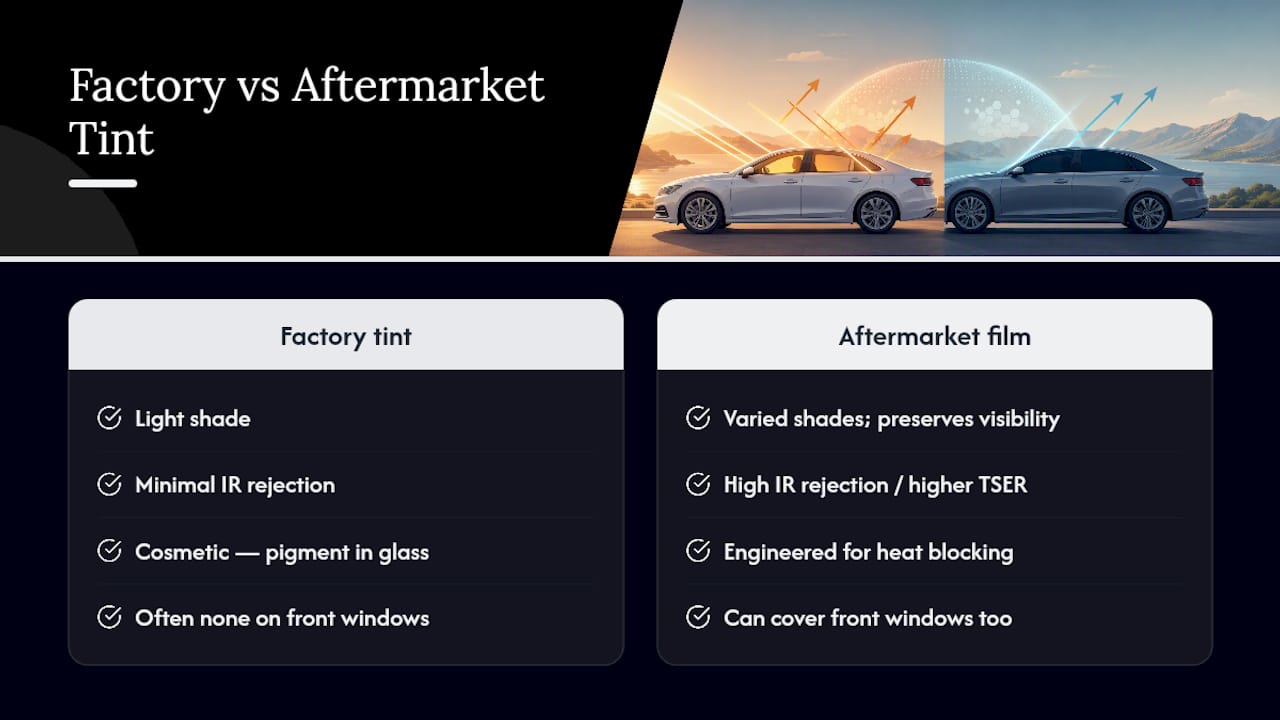
Factory-tinted glass, the kind baked into the glass during manufacturing, is mostly cosmetic. It typically sits in a light shade range and offers minimal infrared rejection, because it wasn’t engineered as a thermal barrier. It’s glass with pigment mixed in, not a spectrally selective film.
Aftermarket window film is a different category of product entirely. A quality ceramic or nano-ceramic film applied after purchase can add TSER and IRR performance factory glass never had, because it’s built specifically to filter infrared while preserving visibility. This is why plenty of new car owners still book aftermarket tint even when their vehicle already has factory-tinted rear glass: the factory layer isn’t doing the thermal work they assume it is.
The gap shows up most on the front windows and windshield area, where laws often restrict factory tinting to nearly nothing, leaving the front cabin exposed to full sun with zero heat-rejecting treatment. Adding a professionally installed film there closes that gap. If you’re weighing whether it’s worth doing at all, our breakdown of what tinting actually does for comfort covers the case in more depth.
One caveat: rear factory tint, even without much IR rejection, does add a privacy layer aftermarket buyers sometimes skip on back glass. Heat rejection and privacy are separate wins, and it pays to know which one you’re actually solving for.
Energy Savings and Interior Comfort From Heat-Rejecting Tint
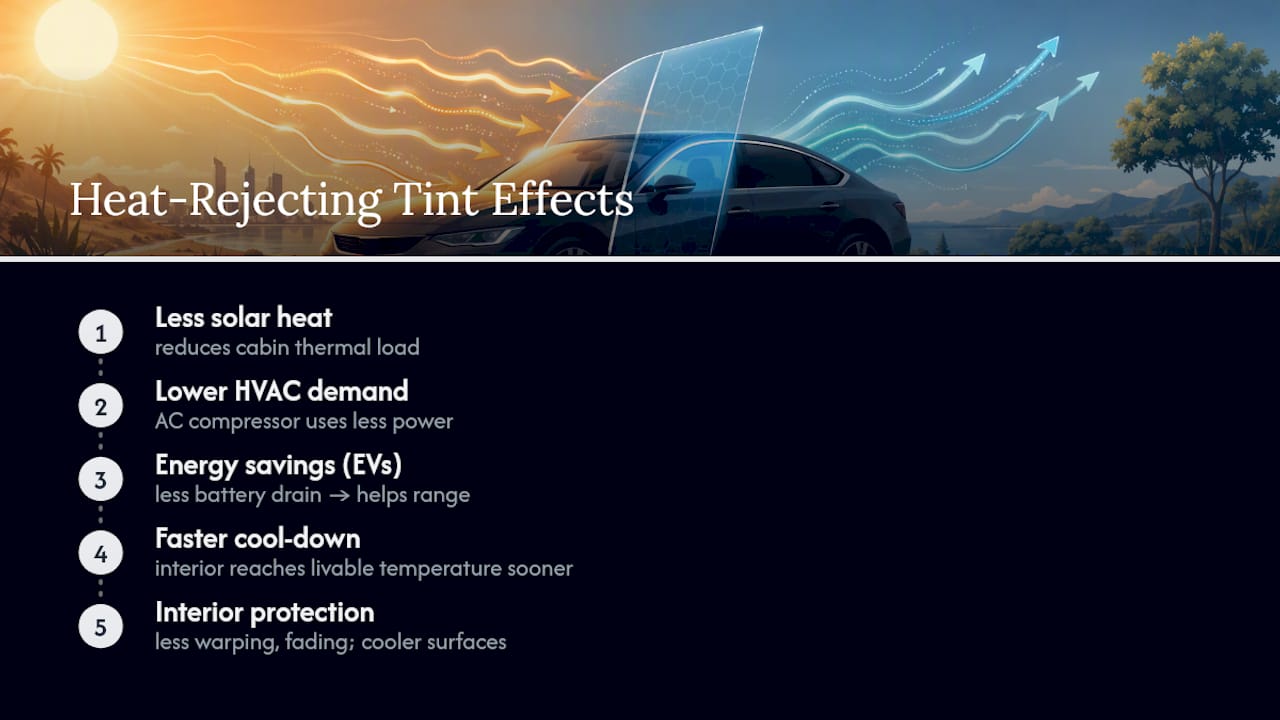
Less solar heat entering the cabin means your AC compressor works less to hit the same temperature, which is the same logic behind energy-efficient window treatments in homes. A car’s HVAC system pulls power from the engine or, in an EV, straight from the battery, so cutting solar load has a real efficiency payoff, not just a comfort one.
Interior comfort improves in ways beyond the thermostat reading. Reduced heat load means less warping risk for dashboard plastics and less fading on seats and trim over years of parking in direct sun. Steering wheels and seatbelt buckles that used to feel scorching after a summer parking lot sit noticeably cooler with a properly specified ceramic film.
EV owners get an added benefit worth flagging: less cabin heat load translates to less battery drain from air conditioning, which matters more for range than it does in a gas vehicle where the AC compressor draws from a bigger, constantly refueled energy source. If range anxiety is part of your calculation, heat rejection isn’t just a comfort upgrade. It’s a small but real efficiency lever.
The comfort difference is most obvious on hot parking days: a car with strong TSER film returns to a livable interior temperature faster than an untinted one, even before the AC kicks in fully. That’s the kind of everyday difference spec sheets don’t capture well but drivers notice immediately. Our energy-saving tint guide goes deeper into the cost side of this equation.
Does Heat Rejection Fade Over Time?
Heat-rejecting performance isn’t permanent, though quality films hold up far longer than cheap ones. Dyed films are the most prone to fading and color shift, since the dye itself breaks down under UV exposure, and as the dye degrades, so does whatever heat-blocking benefit it had.
Ceramic and nano-ceramic films are built with more UV-stable materials and typically maintain their TSER and IRR performance for many years under normal conditions, which is part of why they carry longer warranties than dyed alternatives. Metalized films can face a different durability issue: the metal layer can oxidize or develop haze over extended sun exposure, gradually reducing both clarity and heat rejection.
Installation quality plays a bigger role in longevity than most buyers expect. A film applied with trapped moisture, poor edge sealing, or dirty glass underneath is far more likely to bubble, peel, or discolor early, cutting its effective lifespan regardless of material quality. That’s part of why installer technique around edge trimming and clean bonding surfaces matters as much as the film brand you choose.
Ask any installer for the warranty terms in writing, specifically whether fading and bubbling are covered separately from adhesive failure. A film that’s warrantied against optical and thermal degradation, not just physical peeling, is the stronger long-term bet.
Our Take on Choosing the Right Heat-Rejecting Film
Cdcautodetailing leans toward nano-ceramic films for most modern vehicles. Between the electronics packed into today’s cars and the actual thermal performance difference, the case for ceramic over metalized or dyed film keeps getting stronger. Carbon still earns its place for budget-conscious drivers or darker legal-limit shades where ceramic pricing doesn’t fit. Before booking anywhere, get TSER and IRR figures in writing, confirm cure instructions, and ask exactly what the warranty covers.
— Charles
Book Ceramic Window Tinting With Cdcautodetailing
Cdcautodetailing installs tint at your home or office in South Jersey, so you skip the shop waiting room and get your car back on your own schedule. That’s the practical edge over a traditional storefront install: no dropping the car off for a day, no arranging a ride home.
Our mobile team installs ceramic and nano-ceramic film with documented TSER and IRR specs, so you know exactly what you’re paying for before the appointment, not after. Before booking, ask about your state’s legal VLT limits, request the specific TSER/IRR numbers for the film being used, and confirm the estimated cure time for your schedule. Cdcautodetailing also handles warranty registration on your behalf, so fading or bubbling claims down the road don’t fall on you to track down.
If you’re weighing tint alongside other protection, our ceramic coating service pairs well with tint on the same visit. Ready to get real numbers for your vehicle? Visit our window tinting service page to check availability and request a quote for your car.