
TL;DR:
- The darkest window tint commonly available is 5% VLT, but legality varies by state and window location.
- Choosing the right film involves understanding VLT, film technology, and compliance with local laws for safe and legal driving.
The darkest window tint commonly available is 5% VLT, known as “limo tint”; specialty films can go even lower, around 2–2.5% VLT, but are uncommon outside specialty applications. Whether you can legally use it depends entirely on your state, which window you’re tinting, and what kind of vehicle you drive. There is no single national “darkest legal” tint in the United States.
The short answer: 5% VLT is the standard floor for retail dark films. Some manufacturers, like Gila, produce specialty films at 2.5% VLT that block roughly 97.5% of incoming light. But “darkest available” and “darkest legal” are two very different things. Check your state’s front-side VLT limit before you buy or install anything.
Table of Contents
- Why there’s no single “darkest legal” tint in the U.S.
- What VLT means and how tint darkness is actually measured
- How dark you can actually buy, and which film technology matters
- Safety, nighttime visibility, and how enforcement plays out
- How to pick the right tint for your car
- What a quality installer will actually do
- Key Takeaways
- The case for going lighter and smarter
- Professional window tinting in South Jersey, done right
- Useful sources and where to verify state law
Why there’s no single “darkest legal” tint in the U.S.
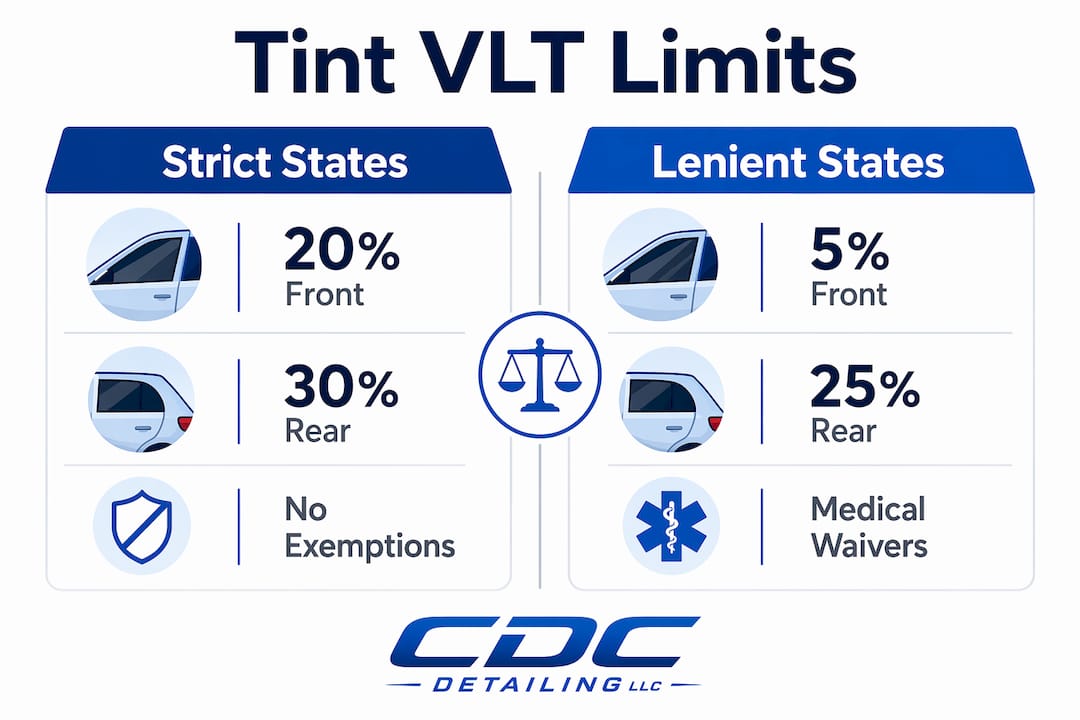
Every state sets its own VLT limits, and most states don’t apply one number to every window. The rules typically vary by window location (front side, rear side, rear window, windshield) and by vehicle type (sedan vs. SUV or multipurpose vehicle). That layered structure is why state laws differ so dramatically from one border to the next.
Front-side windows get the strictest treatment almost everywhere. The reasoning is straightforward: law enforcement needs to see the driver during a traffic stop, and drivers need unobstructed lateral visibility. Rear windows and rear side windows face lighter restrictions in most states, especially on SUVs and trucks.
A few concrete examples show how wide the gap can be. Some states permit front-side tints as dark as 20% VLT. Other states require front-side windows to allow a high VLT, which is close to factory-clear glass. Some states set front-side limits at moderate VLT levels while allowing darker rear window tints on certain vehicles under Florida Statutes §§ 316.2953 and 316.2954. The same 5% limo tint that’s legal on your SUV’s rear glass in one state could get you cited the moment you cross into another.
Sample state VLT limits (front side / rear side / rear window):
| State | Front Side Min VLT | Rear Side Min VLT | Rear Window Min VLT |
|---|---|---|---|
| New York | 70% | Any | Any |
| New Jersey | 70% | Any | Any |
| Florida (sedan) | 35% | — | — |
| Florida (SUV/truck) | 35% | 6% | 6% |
| New Mexico | 20% | 20% | 20% |
| California | 70% | Any | Any |
| Texas | 25% | 25% | 25% |
This table is a general reference. Verify your state’s current statute or DMV page before installation.
Quick check: 5% tint is not legal for front-side windows in any U.S. state. Most states cap front sides at 25–35% VLT or higher.
Many states allow medical exemptions for certain drivers with documented conditions. These exemptions typically require a physician’s letter and a state-issued certificate kept in the vehicle. Laws change, so always confirm the current rule at your state’s DMV or official statute database rather than relying on a third-party summary alone. Resources like TintWiz and Recording Law aggregate state rules usefully, but the statute is the legal authority.
What VLT means and how tint darkness is actually measured
VLT stands for Visible Light Transmission. It measures the percentage of visible light that passes through the combined glass and film. Lower percentage equals darker tint. That math trips people up because it feels backwards: a 5% film is very dark, while a 70% film looks nearly clear.
Here’s how the common VLT percentages map to real-world visibility:
- 70% VLT: Barely looks tinted from outside. Almost factory appearance. Good UV blocking with minimal visual change.
- 50% VLT: Subtle shade. Still see-through in most lighting. Cuts glare noticeably.
- 35% VLT: Looks like real tint. Faces are still visible from outside in daylight. Night visibility remains solid.
- 20% VLT: Noticeably dark. Intentional look. Daytime driving is fine; nighttime requires more attention to mirrors.
- 5% VLT: Limo tint. Hard to see through from outside. Daytime visibility is workable in good light. At night, you will feel the difference.
The measurement that matters for compliance is net VLT, not just the film’s rated percentage. Most factory glass already carries a built-in tint, typically in a high VLT range. When you add a medium tint film to factory glass with high VLT, the combined result is significantly lower than the film rating. Installers and officers both measure net VLT using handheld VLT meters, which read the actual light transmission through the full glass assembly. That’s the number that determines whether you pass or fail a roadside check.
You can explore a window tint shade guide to see how VLT values translate visually before committing to a shade.
How dark you can actually buy, and which film technology matters
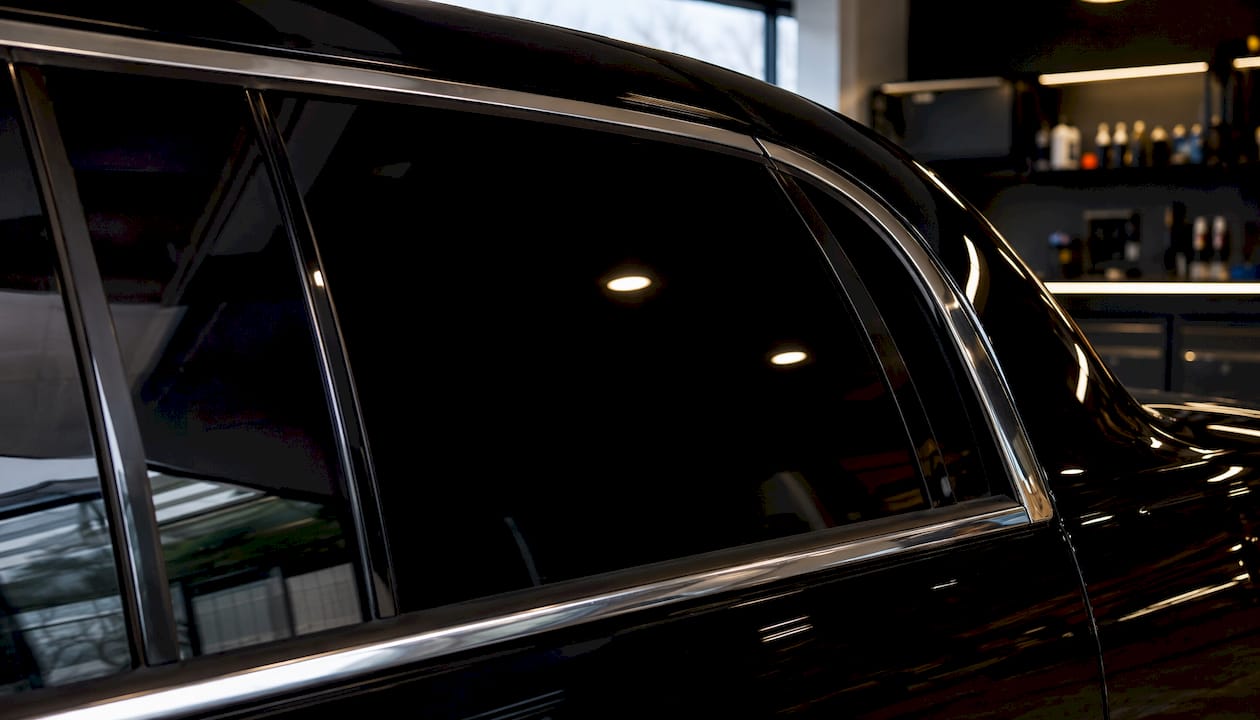
The darkest film you’ll find at most professional shops is 5% VLT, commonly called limo tint. It’s used on limousines, executive vehicles, and rear windows of SUVs where privacy is the priority and the law allows it. Specialty films like the Gila XTREME LIMO BLACK go down to 2.5% VLT, blocking roughly 97.5% of incoming light. Films at that level are rare in professional installs and are generally used on vehicles that won’t be driven on public roads or in states where rear-window limits are unrestricted.
But here’s what most buyers miss: raw darkness and film performance are separate things entirely.
Film technology types and their trade-offs:
- Dyed film: Absorbs light to create darkness. Least expensive. Fades over time, offers limited heat rejection, and provides no meaningful IR blocking. The go-to for budget installs.
- Metalized film: Uses metallic particles to reflect heat and UV. Better heat rejection than dyed. Can interfere with GPS, cell signals, and radio. Slightly reflective appearance.
- Carbon film: No metal, so no signal interference. Good heat rejection and a matte, non-reflective finish. More durable than dyed. Mid-range price point.
- Ceramic film: The top tier. Uses ceramic nanoparticles to block infrared heat and UV without affecting signals. Highest heat and UV rejection at any given VLT. Doesn’t fade. Costs more upfront but lasts significantly longer.
Industry professionals consistently recommend prioritizing film technology over chasing the lowest VLT number. A ceramic film at 35% VLT will keep your car cooler, protect your interior from UV damage, and preserve your nighttime visibility far better than a dyed 5% film. The reasons to invest in ceramic or carbon tint go well beyond aesthetics.
Pro Tip: If your primary goal is heat reduction, a high-quality ceramic film at a legal VLT will outperform a dark dyed film on every metric that matters for daily driving comfort.
Safety, nighttime visibility, and how enforcement plays out
Ultra-dark tints create a real visibility trade-off after dark. At 5% VLT, side mirror sightlines are noticeably compromised at night, and lateral awareness through side windows drops significantly. That’s the core reason front-side windows and windshields carry the strictest limits in every state: those are the windows drivers rely on most for real-time situational awareness.
Many states require dual outside mirrors when rear windows are heavily tinted, precisely to compensate for the reduced rearward vision. If your state mandates it and you skip the mirrors, you’re looking at two violations instead of one.
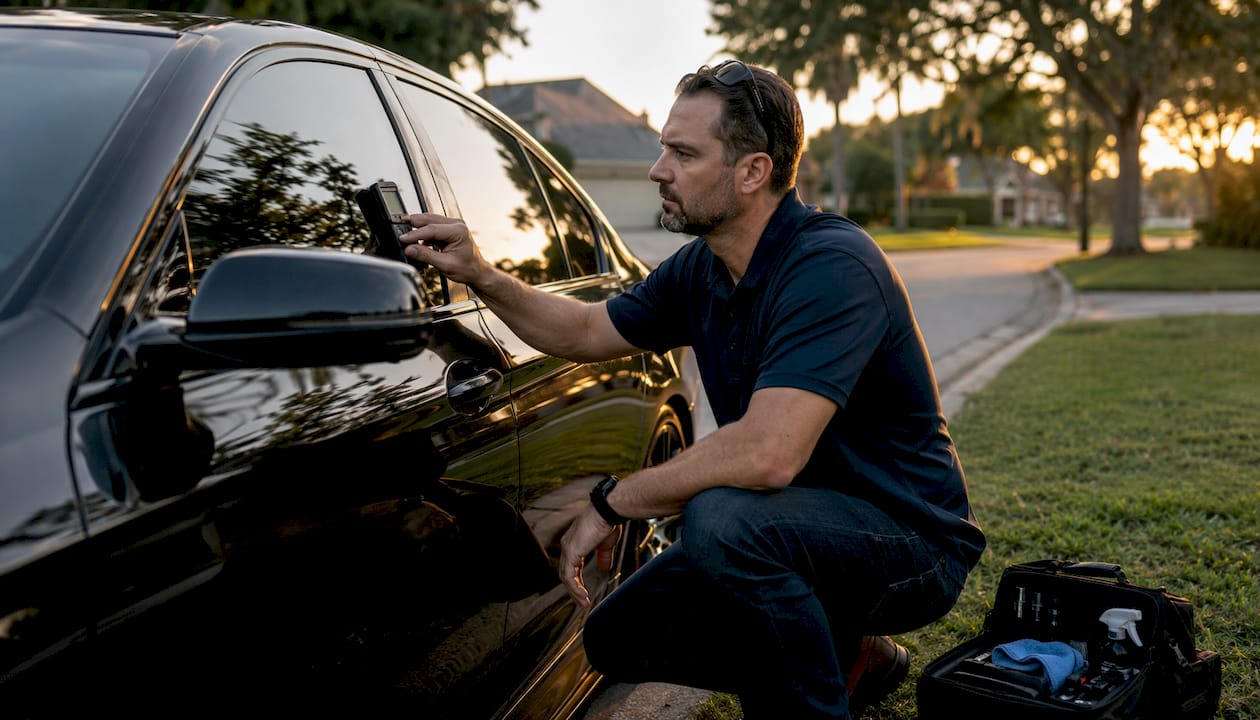
Enforcement works like this: an officer can initiate a stop based on a visual judgment that your tint appears too dark. They’ll use a handheld VLT meter, placed against the glass, to get a reading. That reading is the legal evidence. If you’re cited, you have the right to ask for the specific meter reading and request a written copy of the result. Some states require a certified meter; others accept any calibrated device.
Typical outcomes after a citation include a fine, an order to remove the non-compliant film within a set timeframe, and a re-inspection requirement. Fines vary widely by state and municipality. Ignoring an ordered removal can escalate to a failed registration renewal in some states. If you have a medical exemption, keep the documentation in the vehicle at all times and know your state’s specific exemption process.
How to pick the right tint for your car
The decision isn’t just about how dark you want to go. It’s about matching your goals to a film that’s legal, safe, and built to last.
Step-by-step decision framework:
- Verify your state’s VLT limits for each window and your vehicle type. Front-side limits are the binding constraint for most drivers.
- Set your primary goal. Privacy? Cooling? Glare reduction? Night visibility? Each goal points to a different VLT range and film type.
- Choose film technology first. For daily drivers, ceramic or carbon outperforms dyed on every practical metric. Reserve very dark VLTs for rear windows where the law allows it.
- Confirm installer credentials. Ask whether the shop provides a post-install VLT reading and a written compliance confirmation.
- Get a warranty in writing. Reputable films carry manufacturer warranties against bubbling, delamination, and adhesive failure.
Recommended VLT ranges by driver priority:
- Privacy-first: Darkest legal VLT (typically 5% or 20% depending on window and state) on rear side and rear windows; legal minimum on front sides (typically 25–35% depending on state).
- Heat and UV reduction: Ceramic film at 35–50% VLT on all windows. The technology does the work, not the darkness.
- Night safety first: 50–70% VLT on front sides; darker rear windows are fine since you rely on mirrors anyway.
- All-around balance: 35% ceramic on rear windows, 50% ceramic on front sides. Legal in most states, good performance, minimal night-visibility impact.
On cost: professional window tinting in the U.S. typically runs from around $150–$250 for economy dyed film on a sedan, up to $400–$800 or more for a full ceramic install on a larger vehicle. Exact pricing depends on the vehicle size, film brand, and number of windows. Get a written quote that specifies the film brand, VLT percentage, and warranty terms before you commit. A useful starting point is this window tinting guide that walks through the buyer checklist in detail.
What a quality installer will actually do
A professional tint job follows a specific sequence, and knowing it helps you spot a shop cutting corners.
What a proper installation looks like:
- Glass cleaning: The installer washes and decontaminates every window surface. Any dust or residue trapped under the film causes bubbles that won’t cure out.
- Precise cutting: Film is cut to fit each window exactly, either by hand or using a plotter. Sloppy edges are a quality tell.
- Wet application: Film is applied with a slip solution, positioned, then squeegeed from the center outward to remove water and air pockets.
- Edge finishing: Edges are tucked and sealed cleanly. Lifted edges are the first place film fails.
- Curing period: Most films need 3–7 days to fully cure. Haze or small water pockets during this window are normal and will clear.
- Post-install inspection: A quality installer checks every window for bubbles, lifted edges, and contamination before handing back the keys.
What should appear on your invoice or warranty document: the film brand and product name, the VLT percentage installed on each window, warranty coverage terms (bubbling, delamination, color shift), and a written post-install VLT reading. That last item is the one most shops skip and the one you should insist on.
Pro Tip: Ask your installer to record the VLT meter reading for each window on your receipt. If your vehicle already had factory-tinted glass, confirm they calculated the net VLT, not just the film’s rated percentage. That number is what an officer’s meter will show.
If you want to understand the full preparation process before booking, what you need to tint your car windows covers the materials and prep checklist in detail.
Key Takeaways
The darkest window tint you can buy is a very dark VLT (“limo tint”), but legality depends on your state and window location, and film technology matters more than raw darkness for daily driving comfort.
| Point | Details |
|---|---|
| Darkest available film | 5% VLT (“limo tint”) is the standard; specialty films reach ~2–2.5% VLT but are rarely used on public-road vehicles. |
| No single national legal limit | State laws vary by window location and vehicle type; front-side windows are most restricted, often requiring 25–70% VLT. |
| Net VLT is what officers measure | Factory glass tint combines with aftermarket film; always confirm the combined VLT with a meter after installation. |
| Technology beats darkness | Ceramic or carbon film at a legal VLT delivers better heat and UV rejection than a very dark dyed film. |
| Cdcautodetailing’s approach | Cdcautodetailing provides mobile tint installation in South Jersey with post-install VLT readings and written compliance confirmation. |
The case for going lighter and smarter
There’s a version of this decision that a lot of drivers get backwards. They fixate on the darkest possible tint, assuming that more darkness equals more protection and more privacy. It does deliver privacy, on the windows where it’s legal. But the protection part? That comes from the film’s chemistry, not its color.
A ceramic film at 35% VLT can block over 99% of UV radiation and reject a substantial portion of infrared heat. A cheap dyed film at 5% VLT blocks light but does comparatively little for heat, fades within a few years, and leaves you squinting through your side mirrors at night. The privacy gain on rear windows is real. The trade-off on front windows, where the law won’t let you go dark anyway, is that you’ve paid for darkness you can’t use.
The smarter play for most drivers is to go as dark as the law allows on rear windows and invest in ceramic technology for the front sides. You get the privacy where it’s permitted, the heat and UV rejection everywhere, and you don’t hand an officer a reason to pull you over. Compliance isn’t just about avoiding fines. A tint that passes a VLT meter is one you can forget about. One that doesn’t is a recurring problem every time you drive past a patrol car.
Professional window tinting in South Jersey, done right
Knowing the rules is one thing. Getting the installation right is another.
Cdcautodetailing offers mobile window tinting across South Jersey, bringing the service to your driveway or workplace. Every install includes a post-install VLT meter reading for each window, a written compliance confirmation, and a warranty covering bubbling, delamination, and adhesive failure. Film options include ceramic and carbon grades for drivers who want real heat and UV performance alongside privacy. You choose the VLT; the team confirms it’s legal for your vehicle and state before the film goes on.
Ready to book or want to see what’s available? Start with the window tinting services page for a full breakdown of film options, pricing, and how to schedule a mobile appointment. For a broader look at what professional auto detailing services include, that page covers the full scope of what Cdcautodetailing provides.
Useful sources and where to verify state law
Laws change, and aggregator sites sometimes lag behind statute updates. Always verify at the primary source for your state.
- State DMV pages: Search “[your state] DMV window tint law” to find the official vehicle code or administrative rule. This is the binding legal authority.
- State statutes: Florida’s tint rules, for example, live in Florida Statutes §§ 316.2953–316.2954. Most states publish their vehicle codes online and searchable.
- TintWiz state law aggregator: Useful for a quick state-by-state overview; cross-check against the state statute before installation.
- Recording Law tint guide: Another aggregator with state-by-state breakdowns and notes on vehicle-type differences.
- TintLegal VLT percentage guide: Explains how VLT percentages translate to visible darkness with visual comparisons.
- Cdcautodetailing VLT and shade resources: Color charts, VLT explanations, and U.S. law summaries for drivers weighing shade options.
- Tint & Wraps Customs: A professional tint and vehicle protection shop with detailed information on premium film options and installation standards.
- VLT meters: Ask your installer to use a calibrated meter and record the reading per window. Keep that document in your vehicle alongside any medical exemption paperwork.
This article is general information, not legal advice. Confirm your state’s current VLT limits with your state DMV or a qualified professional before purchasing or installing window film.