
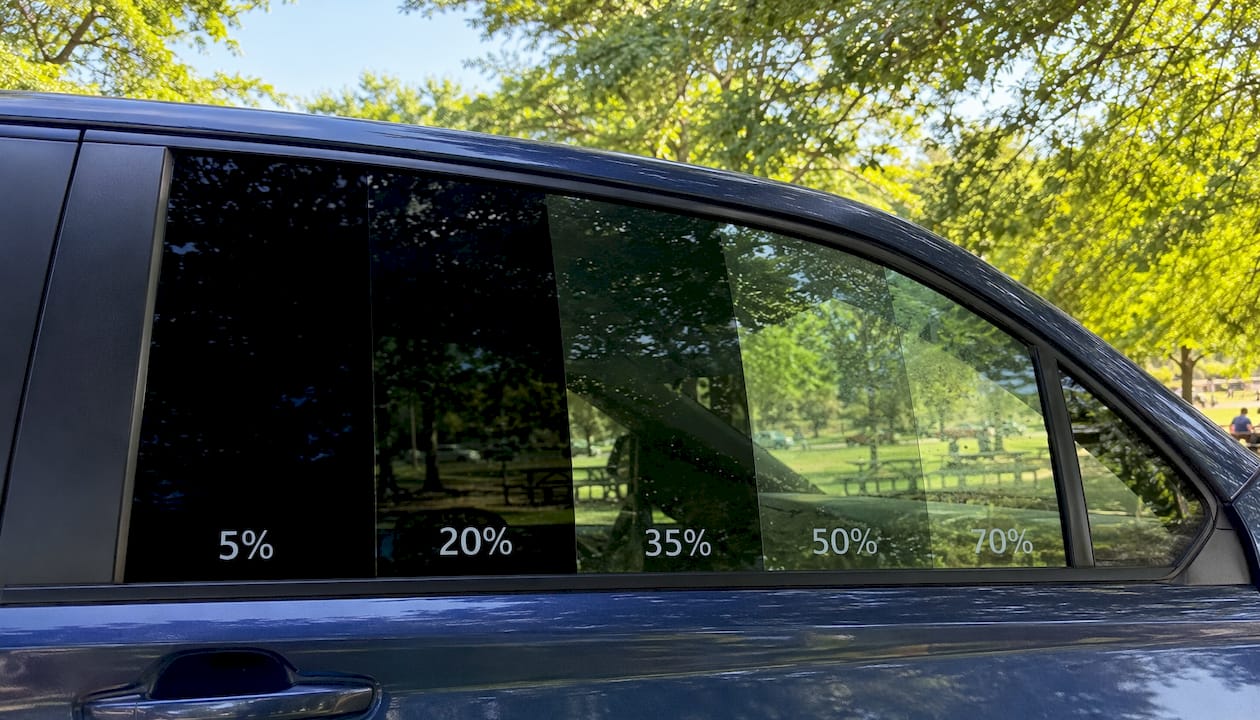
For most South Jersey vehicle owners and fleet managers, a medium range of visible light transmission (VLT) delivering enough privacy and heat rejection to matter, light enough to stay legal on front-side windows in New Jersey, and clear enough for safe nighttime driving in ceramic or carbon film hits the sweet spot: enough privacy and heat rejection to matter, light enough to stay legal on front-side windows in New Jersey, and clear enough for safe nighttime driving.
Three practical starting points from the car tint color chart:
- 35% VLT (medium): Balanced privacy and visibility; the most popular choice for daily drivers and fleet vehicles.
- 20% VLT (dark): Strong privacy on rear windows; check NJ front-side rules before applying here.
- 50% VLT (light): Barely noticeable shade, maximum visibility; good for windshield strips or drivers who prioritize clarity.
Pro Tip: Film curing takes 3–5 days after installation. Keep windows rolled up the entire time. In South Jersey’s humid summers, a poor installer who skips proper adhesion steps will cost you a redo within months.
Table of Contents
- What does the car tint color chart actually show?
- How VLT works and what a tint label tells you
- Which film technology gives you the best performance?
- What are the legal limits for tint in New Jersey?
- How do you pick the right shade for your car or fleet?
- How does the same VLT look on different vehicles?
- South Jersey window tinting from Cdcautodetailing
- How to measure your existing window tint percentage
- Common myths about tint colors and NJ legal limits
- Key Takeaways
- What South Jersey drivers actually get wrong about tint
- Useful sources and further reading
- Cdcautodetailing: South Jersey’s mobile tinting option
What does the car tint color chart actually show?
The chart maps VLT percentages to shade names so you can pick a target number before you ever call an installer. VLT (Visible Light Transmission) is the percentage of light that passes through the film. Lower number, darker glass.

A range of VLT bands correspond to shade names and typical applications, such as very dark limo tint for privacy on rear windows, dark tint for rear side windows, medium tint suitable for front and rear side windows, light tint for front side windows and daily drivers, and very light or near-clear tints for windshield strips or UV-only installs.
In shade or overcast light, every band reads slightly darker than it does in direct sun. A 35% film that looks perfectly balanced on a bright day can feel noticeably dark in a parking garage.
How VLT works and what a tint label tells you
VLT is a measured percentage, not a brand name or a guess. A label reading “35 VLT” means 35% of visible light passes through. The rest is absorbed or reflected by the film. Lower VLT means darker film, with the common range running from 5% (very dark) to 70%+ (very light).
Key things to know when reading a tint label:
- VLT number: The core spec. Confirm it matches what the installer quoted.
- UV rejection %: Separate from VLT. A film can be light (high VLT) and still block nearly all UV.
- Film series code: Tells you the technology (dyed, carbon, ceramic). Ask the installer to explain it.
- Certification label: A small sticker placed between the film and glass after install. New Jersey law enforcement may ask for it during a stop.
Interior trim color changes how dark a tint feels even when the VLT number is identical. A 20% film on a black interior reads darker than the same film on a beige or tan interior. Glass curvature on SUVs and trucks also affects perceived darkness compared to flat sedan glass.
Which film technology gives you the best performance?
Film type determines how well your tint handles South Jersey summers. VLT is just the darkness level; the film’s construction decides heat rejection, UV blocking, and how long it lasts.
Film types vary in UV protection, heat rejection, possible signal interference, price range, and longevity, with dyed film being a budget-friendly but lower-performance option, metalized offering high protection but possible signal interference, carbon providing high protection without interference at moderate cost, and ceramic delivering excellent UV blocking and heat rejection without interference at a premium price and longer lifespan.
Ceramic film uses nanoparticles to block up to 99% of UV rays and reject significant solar heat without touching your phone signal, GPS, or toll transponder. For fleet vehicles that rely on telematics or mobile devices, that matters. Carbon is the practical middle ground: no signal interference, solid UV and heat performance, and a lower upfront cost than ceramic.
Dyed film is the budget entry point, but it fades faster and offers the least heat rejection. In a South Jersey summer, that trade-off shows up fast.
Pro Tip: For carbon vs. ceramic decisions on fleet vehicles, run the math on replacement cycles. Ceramic’s higher upfront cost often pays back over a 5-year fleet ownership period through fewer reapplications.
What are the legal limits for tint in New Jersey?
There is no federal tint law in the United States. Every state sets its own limits, and they vary by window position and vehicle type. Installing a shade that is legal in Pennsylvania may earn you a fix-it ticket the moment you cross into New Jersey.
Steps to confirm you are legal before installation:
- Check the NJ Motor Vehicle Commission for current front-side and rear-window VLT minimums.
- Note that front-side windows typically require a higher VLT (more light) than rear-side or rear windows.
- Ask your installer for the VLT certification label, which documents the film’s measured transmission.
- Keep a copy of that label in the vehicle. Officers can request it during a traffic stop.
Extremely dark tints in the 5%–15% VLT range are restricted or prohibited on front-side windows in many states because they impair night visibility. Violations can mean fines and mandatory film removal at your expense. Verify the current NJ rules directly with the MVC before booking any install.
This article is general information, not legal advice. Confirm current tint limits with the NJ Motor Vehicle Commission or a qualified professional for your specific vehicle.
How do you pick the right shade for your car or fleet?
Work through these questions before requesting a quote:
- What is your primary goal? Heat rejection, privacy, UV protection, or aesthetics? Each shifts the ideal VLT and film type.
- What windows are you tinting? Front-side windows face stricter legal limits than rear windows.
- What is your interior color? Dark interiors amplify perceived darkness; adjust your target VLT up by 5–10% if you have a black interior.
- Do you drive at night regularly? Anything below 20% VLT on front windows creates real visibility risk after dark.
- Is this a fleet? Standardize on one VLT and one film type across all vehicles for uniform appearance and simpler compliance documentation.
- What is your budget? Dyed starts around $100–$200; ceramic runs $400–$800+ per vehicle.
When you talk to an installer, ask these specifically: Do you provide a written warranty? What failure modes does it cover? Can you show before-and-after photos of prior installs? What is your curing policy, and how do you handle humid-weather installs? A professional installer will answer all of these without hesitation. For a flawless finish, written warranty terms and documented curing procedures are non-negotiable trust signals.
Poor installation causes bubbling, peeling, and gaps regardless of film quality. Installer skill is as important as the film you choose.
How does the same VLT look on different vehicles?
A 20% VLT is not a fixed visual experience. Perceived darkness shifts with interior trim color, external lighting, and glass curvature. That same 20% film looks noticeably darker on a black-interior sedan than on a tan-interior SUV with curved rear glass.
For visual reference, ask your installer for sample shots in three conditions: direct sunlight, open shade, and nighttime with interior lights on. Those three views tell you more than any single showroom sample.
Fleet managers: Standardize on one VLT and one film series for every vehicle in the fleet. Mixed VLTs across a fleet look inconsistent and complicate compliance paperwork. Schedule batch installs to keep the fleet uniform and to negotiate better per-vehicle pricing. Document any exemptions (vehicles with medical or cargo exemptions) separately. Pairing a consistent tint spec with coordinated exterior styling reinforces a professional brand image across the whole fleet.
Also: avoid ammonia-based window cleaners on tinted glass. Ammonia breaks down the film’s adhesive and causes discoloration. Use an ammonia-free cleaner and a microfiber cloth.
South Jersey window tinting from Cdcautodetailing
South Jersey drivers have a specific problem: hot, humid summers that punish cheap film and sloppy installs. Cdcautodetailing offers mobile window tinting in Pitman and across South Jersey, bringing ceramic and carbon film options directly to your location.
The service covers ceramic and carbon film installs for individual vehicles and fleet packages, with written warranties, VLT certification labels, and documented curing policies included. Fleet managers can request an on-site estimate for batch installs, which simplifies scheduling and keeps the fleet consistent. For a full picture of what the service covers, the window tinting guide walks through film options, pricing, and what to expect on install day. Fleet-specific packages are detailed on the fleet detailing page. Request a quote or schedule your install at cdcautodetailing.com.
How to measure your existing window tint percentage
If you bought a used vehicle or inherited a fleet and need to verify the current VLT, here is how to do it accurately:
- Use a tint meter. A handheld light-transmission meter (tint meter) is the only reliable way to measure VLT. Installers and inspection stations carry them.
- Test each window separately. VLT can vary between front-side, rear-side, and rear windows if previous owners applied different films.
- Test in consistent light. Measure indoors or in open shade; direct sunlight can skew readings.
- Check the certification label. Look between the film and the glass edge for a small label showing the measured VLT. Not all installs include one, but professional installs should.
- Compare to NJ limits. Once you have the number, check it against current NJ MVC guidelines for each window position.
A tint meter reading of 32% on a front-side window, for example, tells you whether you are within the legal threshold before a traffic stop does.
Common myths about tint colors and NJ legal limits
Myth: “Factory tint counts toward the legal limit.” Partially true but often misunderstood. Factory privacy glass has a built-in VLT, and in New Jersey, the combined VLT of the glass and any added film is what matters. Adding a 35% film to factory glass that already transmits 20% of light produces a combined VLT well below 35%.
Myth: “Darker tint means more UV protection.” Not automatically. UV rejection depends on film technology, not darkness. A 70% ceramic film can block nearly all UV while a 20% dyed film may let significant UV through. Check the UV rejection spec separately from the VLT number.
Myth: “If it’s legal in another state, it’s fine in New Jersey.” Wrong. State tint laws vary significantly, and NJ has its own front-side minimums. A tint that passed inspection in Delaware or Pennsylvania may fail in New Jersey.
Myth: “You can tint the windshield any shade you want.” No. New Jersey, like most states, restricts windshield tint to a small strip at the top (the “brow”), and that strip must meet reflectivity and VLT standards.
Myth: “Bubbling means the film is too dark.” Bubbling is an installation defect, not a darkness issue. It happens when adhesive cures improperly, often because windows were rolled down too soon or the installer skipped surface prep.
Key Takeaways
For most South Jersey drivers, a medium range of visible light transmission (VLT) delivering enough privacy and heat rejection to matter, light enough to stay legal on front-side windows in New Jersey, and clear enough for safe nighttime driving in ceramic or carbon film is the practical choice that balances heat rejection, UV protection, legal compliance, and nighttime visibility.
| Point | Details |
|---|---|
| Target VLT for most drivers | a medium range of visible light transmission (VLT) delivering enough privacy and heat rejection to matter, light enough to stay legal on front-side windows in New Jersey, and clear enough for safe nighttime driving covers daily driving, legal front-side limits, and adequate privacy. |
| Best film technology | Ceramic blocks up to 99% of UV and rejects heat without signal interference; carbon is the cost-effective alternative. |
| Legal check is mandatory | No federal tint law exists; verify current NJ MVC limits for each window position before booking. |
| Installer quality matters | Demand a written warranty, VLT certification label, and a documented 3–5 day curing policy. |
| Cdcautodetailing for South Jersey | Mobile ceramic and carbon installs with fleet packages and written warranties across South Jersey. |
What South Jersey drivers actually get wrong about tint
The biggest mistake South Jersey owners make is treating VLT as the only variable. They pick a darkness level, find the cheapest installer who offers it, and then wonder why the film is bubbling by the following summer. The film technology and the installer’s workflow matter at least as much as the number on the label.
Ceramic film’s UV blocking is the detail most people overlook. A light 50% ceramic film protects your interior and skin from UV damage just as effectively as a dark 20% dyed film, without the visibility trade-off or the legal risk on front windows. For South Jersey’s long, sun-heavy summers, that is a meaningful difference.
Fleet managers have an additional blind spot: they standardize on price per vehicle rather than total cost of ownership. A dyed film at $150 per vehicle that needs replacement in three years costs more over a five-year fleet cycle than ceramic at $500 per vehicle that lasts a decade. Run the numbers before the first install.
Spring installs, before the peak humidity of July and August, give adhesives the best curing conditions. If you are scheduling a fleet batch, April through early June is the window to target.
Useful sources and further reading
- NJ Motor Vehicle Commission: The primary source for current New Jersey window tint limits by window position and vehicle type. Check here before any install.
- Window tint VLT percentages explained: A detailed breakdown of how VLT is measured and what the numbers mean in practice.
- Window tint laws by state: Confirms there is no federal tint standard and summarizes state-by-state variation.
- AAA on film types: Practical overview of ceramic, carbon, metallic, and dyed films with UV and heat rejection context.
- Curing time guidance: Explains the 3–5 day curing window and why climate affects adhesive set.
- Cdcautodetailing window tint color chart: Local VLT reference and US law context for South Jersey drivers.
- Request VLT lab data from your installer. Any professional installer should provide a certification label and, on request, the film’s technical data sheet showing UV rejection, VLT, and heat rejection specs.
Cdcautodetailing: South Jersey’s mobile tinting option
If you have read this far, you know what you need: a specific VLT, a film technology that handles South Jersey heat, a legal install, and an installer who backs their work in writing. Cdcautodetailing delivers all of that without requiring you to drive to a shop.
Mobile ceramic and carbon window tinting, fleet batch packages, written warranties, and VLT certification labels, all scheduled around your location in South Jersey. Individual vehicle owners get the same professional-grade install as fleet clients. The window tinting service page has film options and pricing details. Fleet managers can start with the fleet enhancement overview to see how batch installs and uniform specs work in practice. Book your install or request a fleet quote at cdcautodetailing.com.